Francis Chung/POLITICO via AP Images
U.S. and Israel diverge over the road map to Damascus
The Trump administration’s eagerness to normalize relations with Syria’s new government is echoing advocacy from leading Biden officials


 Add JewishInsider on Google
One year after the fall of the Assad regime in Syria, policymakers and officials in the United States and Israel remain increasingly divided over how to confront the changing landscape in Damascus.
Following the fall of Bashar al-Assad in December 2024, the IDF moved into a U.N. buffer zone inside southern Syria to protect Israel’s northern border as Damascus’ military and political landscape shifted. A year later, against Damascus’ wishes, Israel still controls the 155-square-mile area and has proceeded to carry out arrests of terror suspects, while also seizing weapons and conducting targeted airstrikes.
These actions have collided with President Donald Trump’s push to broker a security agreement and end hostilities between the two countries, which the president and some experts see as a key part of stabilizing Syria — and, ultimately, the region. The Trump administration has often sided with Damascus in recent disputes, warning that Israel’s strikes are undermining efforts to reach an agreement, which the White House also views as a path to normalization.
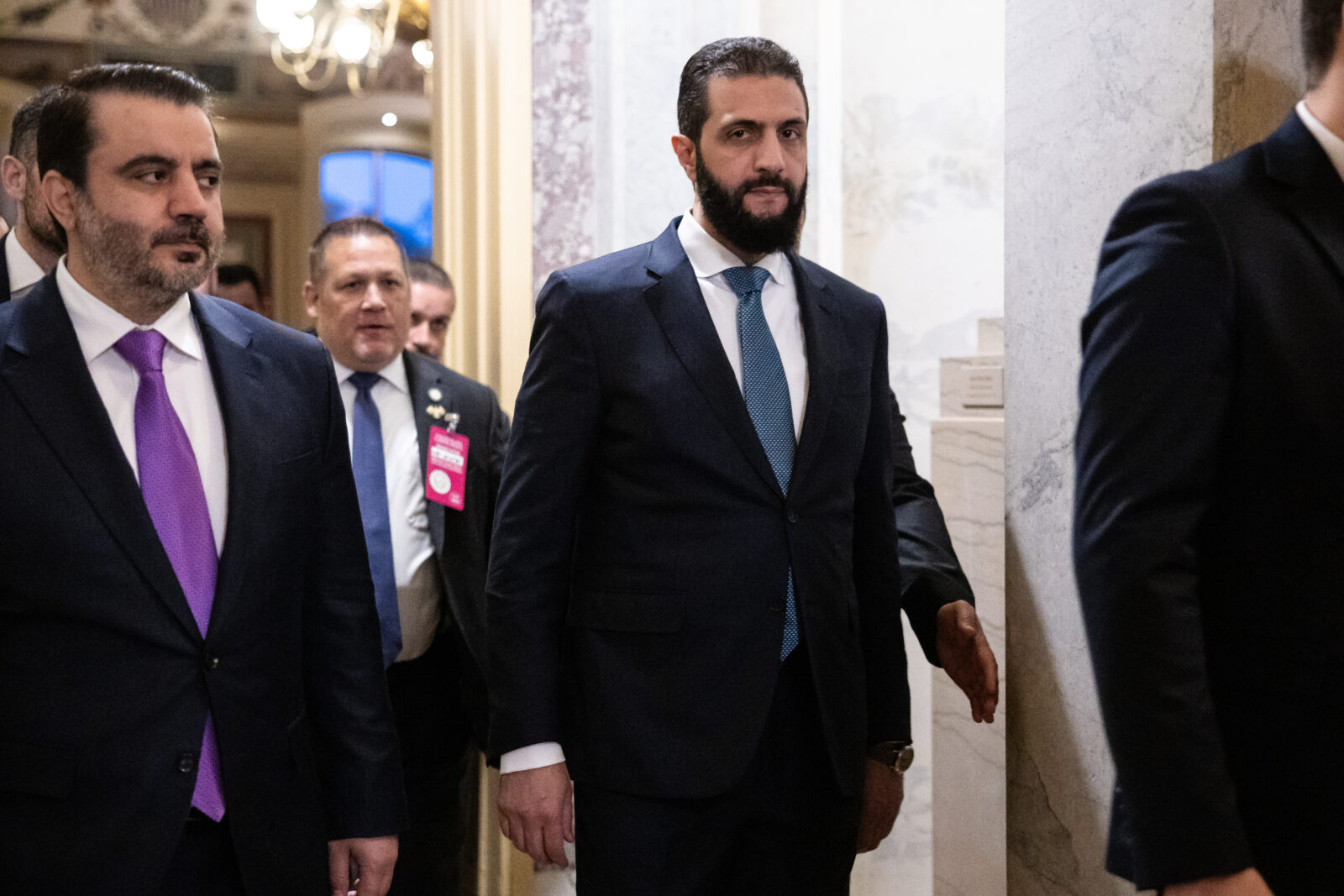
Israeli Prime Minister Benjamin Netanyahu maintains that any agreement must require Syria to accept the demilitarization of territory stretching from southern Damascus to the Israeli border. However, Syrian President Ahmad al-Sharaa has rejected this condition, arguing that it would create a dangerous security vacuum in southern Syria.
Critics of al-Sharaa and some in the pro-Israel community have remained wary of relinquishing the area to the Syrian government given al-Sharaa’s past ties to Al-Qaida, a U.S.-designated Foreign Terrorist Organization that he joined following the 2003 U.S. invasion of Iraq. While operating for the group as a foot soldier, al-Sharaa was captured by U.S. military forces and imprisoned, and he later founded one of the terror group’s Syrian branches.
“In [Israel’s] perspective, the problem is mistrust as well as hard security indicators,” Ahmad Sharawi, a research analyst at the Foundation for Defense of Democracies, told Jewish Insider. “Southern Syria is awash with weapons, weapon trafficking routes and Iran-backed networks. At the same time, Israel is being asked to make concessions to a government led by a former Al-Qaida emir whose coalition still includes figures that praised the Oct.7 attacks and openly endorse armed resistance against Israel.”
Jonathan Ruhe, a fellow at the Jewish Institute for National Security of America, explained that Israel is concerned that should a deal be made, it could allow for “potentially hostile forces to encroach anywhere near the border.” In a conversation with the Hudson Institute last month, Caroline Glick, international affairs advisor to Netanyahu, said keeping threats away from Israel’s borders has become an instrumental part of the Israeli government’s foreign policy in the aftermath of the Oct. 7, 2023, terrorist attacks.
“Defense is simply not an option for such a small country, and thus the security of each and every border matters more for Israel than most any other country,” said Ruhe. “To be viable for Israel, a deal would have to demilitarize southwest Syria and probably include real prohibitions on Turkish military presence in Syria. It also likely would have to permit Israel to use Syria as an air corridor to Tehran, or at least not openly prohibit this.”
Reflecting the views of those urging an accommodation towards the new Syrian government, Barbara Leaf, assistant secretary of state for Near Eastern affairs under the Biden administration, maintained that Israel has nothing to worry about with a normalized al-Sharaa government.
Participating on a panel at the Middle East Institute on Wednesday, Leaf refrained from addressing Israel’s security concerns, instead arguing that Syria holds no hostile posture towards the Jewish state and that Israel’s actions are prohibiting an agreement. She pushed for the U.S. to exert more pressure.
“There’s no other recourse but for the White House to come down very hard and definitively on the Israeli government to stop the bombing and to start making plans to pull back from that border and get serious and finish this set of discussions,” said Leaf.
Sharawi suggested that Israel remains hesitant and has taken a “far more pessimistic view of Syria’s short-term trajectory.
“Even if al-Sharaa himself is signaling restraint, Israeli decision-makers are deeply skeptical that his control is durable or that he would retain power long enough to enforce any agreement,” said Sharawi.
Last month, Trump administration officials indicated that a security deal was “99% done,” with hopes that Trump’s Oval Office meeting with al-Sharaa in November could help push the agreement over the line. But talks continue to stall.
Gideon Sa’ar, Israel’s foreign minister, said on Wednesday that the gap between the two sides has grown, as the Syrians have added new demands.
Ruhe said it may also be tricky for the White House to fast-track an agreement as Trump could have less room to exert pressure on Israel.
“Partly it’s a question of how much pressure Trump can still apply to Israel, since he already leaned hard on Netanyahu to agree to the Gaza ceasefire,” said Ruhe. “Any foreseeable deal would be a narrow nonaggression pact, not Syria joining the Abraham Accords as Trump may wish.”