



























Trump to host President al-Sharaa in historic visit as U.S. eyes Israel-Syria security deal
The meeting with al-Sharaa could help push a U.S.-brokered Syria-Israel security agreement across the finish line
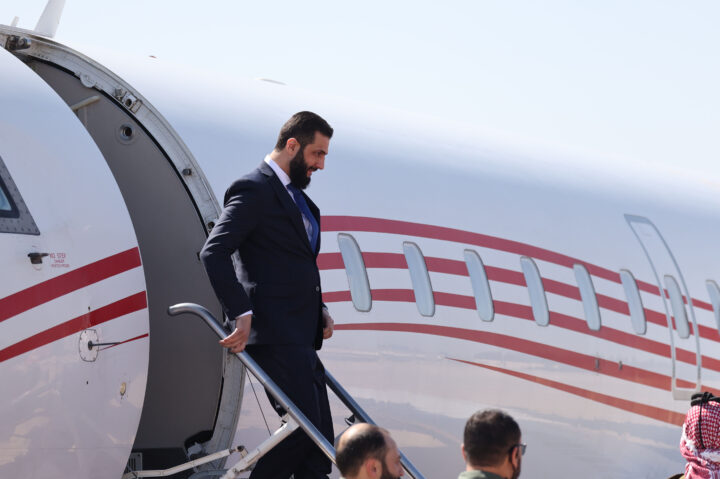
Salah Malkawi/Getty Images
Syrian President Ahmad al-Sharaa arrives at Marka airport on Feb. 26, 2025 in Amman, Jordan.


 Add JewishInsider on Google
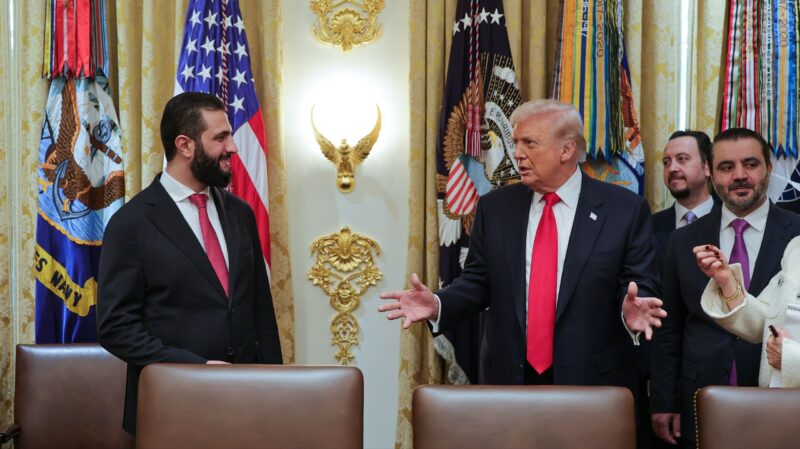
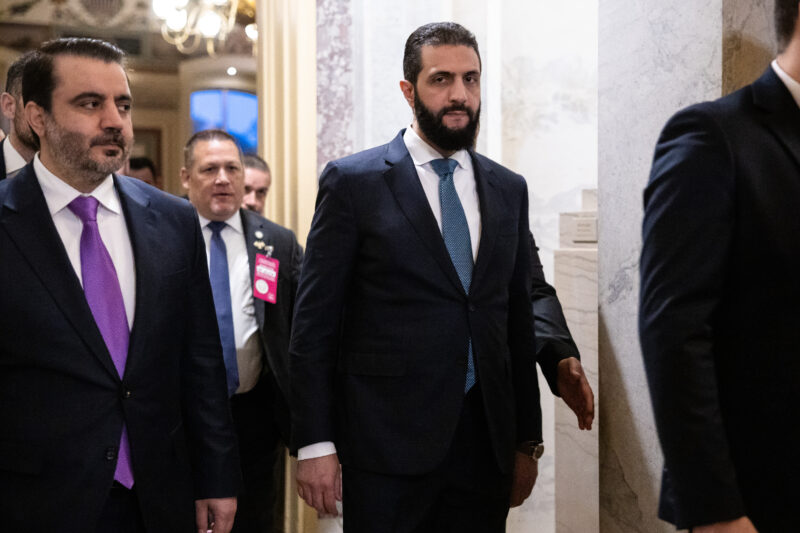
When Syrian President Ahmad al-Sharaa visits the White House on Monday, he will be the first Syrian head of state to do so, a long-anticipated meeting that could advance U.S. efforts to broker a potential security agreement between Syria and Israel.
The U.S. has worked on mediating a security deal between the two nations this year following the fall of the Iran-aligned Assad regime and Israel’s decisive military action against Hezbollah in Lebanon, something that Israeli Prime Minister Benjamin Netanyahu said made the talks “possible.”
After the fall of Assad, the IDF entered a U.N. buffer zone inside Syria in order to protect its own borders as the country’s military and government were in flux. Reports indicate that Damascus is seeking an end to the Israeli presence there, while Israel is calling for the demilitarization of southwest Syria and for al-Sharaa’s government to take more responsibility for the security of the Druze minority in the region.
“Israel’s main concerns center on the deployment of Syrian forces in the south and the protection of the Druze minority, while Syria remains wary of leaving large parts of southern territory outside its control,” said Ahmad Sharawi, a research analyst at the Foundation for Defense of Democracies.
Trump administration officials have said in recent months that the security deal is “99% done,” though it has yet to be finalized.
Experts told Jewish Insider the visit could allow the parties to work out the details of the agreement and push the long-awaited security deal to completion — a development that would further cement Damascus’ strategic realignment with Washington and Israel and foster reduced dependence on Iran.
“Regrettably, a much-discussed Syria-Israel security agreement is evidently not ready to be announced, but it is hoped that the visit will help push the agreement over the finish line,” said Robert Satloff, executive director of The Washington Institute for Near East Policy, who called the visit a “landmark event.”
“Al-Sharaa’s visit to the White House is significant because it marks the first time Washington has treated Damascus not as an adversary, but as a potential partner,” said Sharawi. “There is a real possibility that this meeting could move both sides closer to signing such an agreement.”
To bolster a potential agreement, the U.S. is also preparing to deploy forces to an airbase near Damascus, according to Reuters. The move would mark the first direct American military presence in the Syrian capital, even as President Donald Trump has advocated for reduced or nonexistent military involvement in the region.
Shawari says a potential U.S. military presence at an airbase near Damascus would represent a “turning point” in the talks.
“For Israel, a limited U.S. presence would provide Israel with a guarantor to keep the Syrians in check; for Damascus, it would signal goodwill toward Washington and a willingness to align with U.S. strategic interests in promoting regional stability,” said Shawari.
Trump has worked on normalizing U.S. relations with the new Syrian government during his second term. During his Middle East visit in May, Trump became the first American president in 25 years to meet with a Syrian leader and announced an end to U.S. sanctions on Syria for the first time in more than a decade.
The U.S. requested that the United Nations lift sanctions on al-Sharaa ahead of the visit — a move the Security Council approved on Thursday. The decision allows the U.S. to legally remove al-Sharaa from the Specially Designated Global Terrorist list and follows the State Department’s July 2025 decision to delist his faction, Hay’at Tahrir al-Sham (HTS), as a Foreign Terrorist Organization. The Trump administration has also expressed support for repealing the congressionally mandated Caesar Act sanctions on Syria, a move the Senate is considering.
“I’m glad that the @UN Security Council lifted its sanctions on Syria,” wrote Sen. Jim Risch (R-ID), the Senate Foreign Relations Committee Chairman, on X on Friday. “This will benefit the Syrian economy and its people. Along with @potus, my colleagues and I are working to repeal Caesar sanctions so Syria can become a safe and prosperous partner for the U.S. in the Middle East.”
The Oval Office meeting also comes on the heels of an announcement Thursday that Kazakhstan will be joining the Abraham Accords, a move that Trump administration officials said they hoped would help build momentum for the Accords ahead of the meeting and a later visit by the Saudi Crown Prince Mohammed bin Salman on Nov. 18.
“President Trump has advocated for Syria’s inclusion in the Abraham Accords since lifting sanctions in May,” said Sharawi. “But, al-Sharaa himself has described that step as unrealistic for now, while signaling that he’s open to a security agreement modeled on the 1974 disengagement accord.”
The 1974 Separation of Forces Agreement — a resolution that was passed by the U.N — established a zone of separation between Israel and Syria and called for the disengagement of forces following the 1973 Yom Kippur War.
In a webinar hosted by The Washington Institute for Near East Policy on Friday, former Israeli Ambassador to the U.S. Michael Herzog — who said an “active U.S. role” is essential for the deal — questioned the effectiveness of using the previous agreement as a template.
“There is still the framework of the 1974 disengagement agreement between Israel and Syria following the 1973 war, but that is outdated,” said Herzog. “We need a new framework and new structure.”
Sharawi noted a new framework for cooperation between Syria and Israel could be based on “shared security threats” such as Iran and Hezbollah — a point Herzog also emphasized.
“Both Israel and al-Sharaa would take action [under a security agreement] to prevent Hezbollah from reasserting itself in Syria or Iranians smuggling weapons and munitions to Hezbollah in Lebanon through Syria,” said Herzog. “So this is a very big deal, but there are also risks.”
“The biggest opportunity is the fact that both al-Sharaa and Israel regard Iran and the Iranian axis as an enemy,” Herzog added. “Syria was a vital link in the Iranian axis and this is no longer the case — an indirect outcome of Israel turning the tables on Hezbollah and later on Iran.”
Satloff said there are steps al-Sharaa could take — whether as part of the emerging agreement or through independent gestures — to further strengthen regional security and demonstrate Damascus’ commitment to peace.
“One area where President al-Sharaa could make a singular contribution to broader Middle East peace is to publicly clarify an issue that has provided Lebanon’s Hezbollah with fodder for its ‘resistance’ against Israel — that is, for Syria to state that the disputed Shebaa Farms and divided town of Ghajar were Syrian territory when taken by Israel, not Lebanese,” said Satloff, referring to a disputed area along the Lebanon-Syria-Israel border that has been under Israeli control since 1967 but is claimed by Lebanon with Syrian backing. “This would pull the rug from under Hezbollah and undermine much of its rationale for continuing the fight against Israel.”
More Stories
olive branch
Rabbi Ammiel Hirsch, outspoken backer of Israel, leaves meeting with Mamdani ‘encouraged’
rabbinic rebuke
Over 800 rabbis speak out against Mamdani as threat to ‘safety and dignity of Jews in every city’
LAYING DOWN THE LAW
Trump: ‘Final documents are being drawn’ to designate Muslim Brotherhood as terrorist group

AI ALERT
ADL study finds leading AI models generate extremist content after antisemitic prompts
diplomats declared
Israel approves new consuls-general in San Francisco, Houston