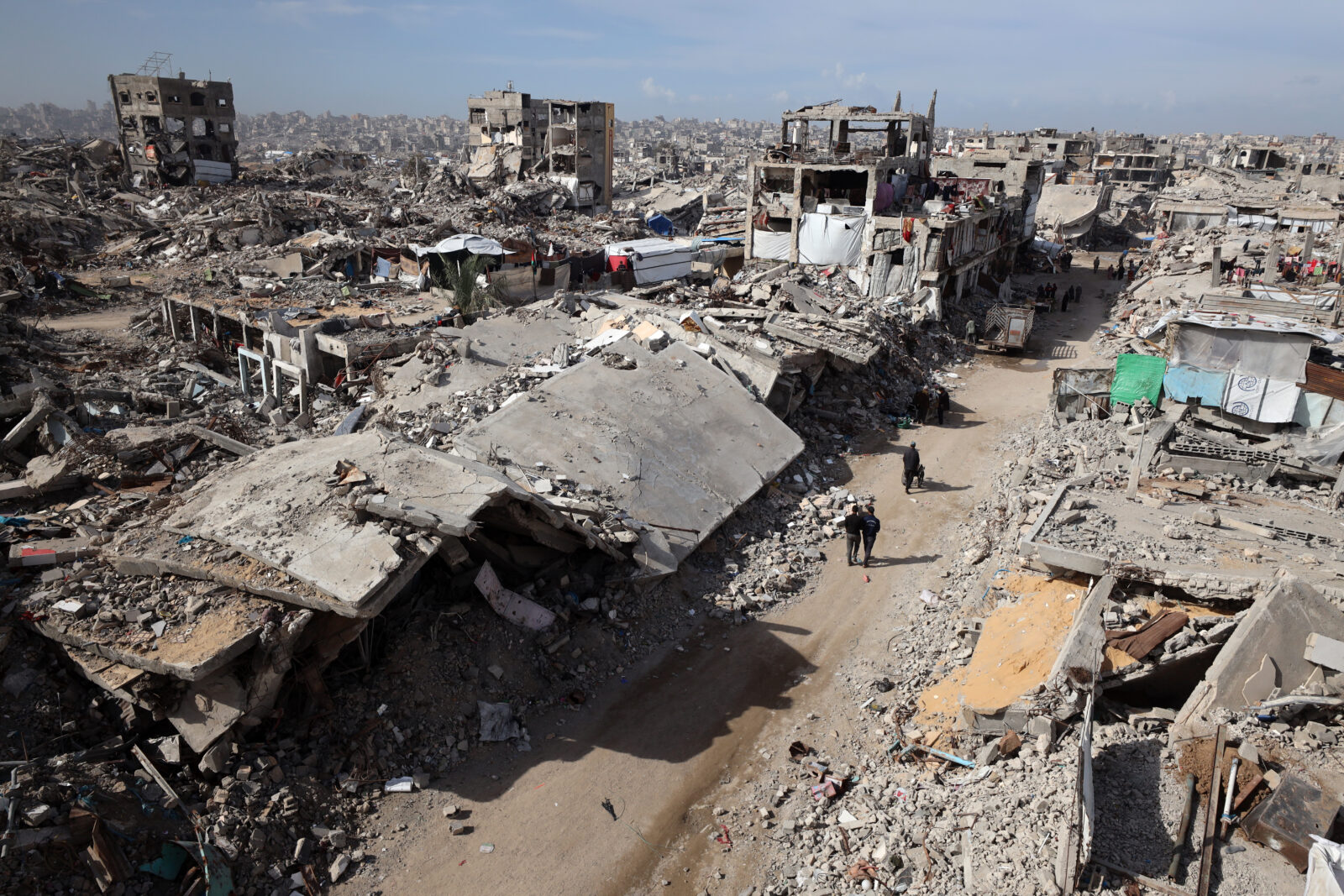
Majdi Fathi/NurPhoto via Getty Images
Trump administration struggles to lay out clear vision for Gaza peace plan
Experts said the White House needs to clarify how governance and security structures will operate in Gaza moving forward


 Add JewishInsider on Google
It has been nearly three months since President Donald Trump unveiled his 20-point peace proposal for Gaza, but officials have yet to explain how key aspects would function in practice or how Hamas’ entrenched presence in the enclave will be addressed.
Under the plan, Gaza’s governance would be overseen by a Trump-led “Board of Peace,” followed by an international executive board expected to include Jared Kushner and White House Special Envoy Steve Witkoff. Beneath the board would sit a technocratic Palestinian government of approximately a dozen Palestinians who are not affiliated with Hamas.
Trump initially planned to announce board members by Christmas, but that timeline has slipped to early next year. On Thursday, the White House proposed that Nickolay Mladenov, a Bulgarian diplomat and former UN Middle East envoy, join the Trump-led board as an on-the-ground representative in Gaza. In such a role, Mladenov would be expected to work with a future Palestinian technocratic government.
But as Trump focuses on hand-picking members for his ideal Palestinian governing body, experts told Jewish Insider that the administration has offered little clarity on how this layered structure would actually govern Gaza — or, more consequentially, how it can operate while armed Hamas terrorists remain in control of much of the enclave.
“It just hasn’t been made clear on the issue of governance or security how this stuff is actually going to work, or how Hamas is going to be persuaded to step aside,” said Aaron David Miller, a senior fellow at the Carnegie Endowment for International Peace. “Is [the Board of Peace] the overriding executive authority that has the final say in Palestinian governance and security? If that’s the case, it’s going to fail because none of these members of the Board of Peace have the time or inclination to make those decisions.”
Israel currently controls 53% of Gaza, as demarcated by the “Yellow Line,” while Hamas maintains control in the remaining western part of the enclave. Despite heavy losses, Hamas fighters continue to operate and have given no indication of relinquishing power. Miller called the task of ensuring Hamas is “stripped of its weapons” an “extremely difficult” objective.
“There is no indication that Hamas is ready to meet its commitments to disarm,” said Dana Stroul, research director at The Washington Institute for Near East Policy. “If anything, [Hamas’] surviving leaders are deliberately muddying the messaging to make their terrorist organization appear reasonable and a legitimate representative of the Palestinian people.”
To prevent a Hamas resurgence, Trump has made the deployment of an International Stabilization Force (ISF) a central pillar of the plan. But the administration has yet to define the composition of the force. Israel has objected to Turkish participation, and while countries such as Azerbaijan and Indonesia have been floated as part of the force, it lacks definitive commitments.
Elliott Abrams, who served as Iran envoy during Trump’s first term, told JI that the White House has yet to “seriously address the question of who would maintain security in Gaza and prevent a Hamas recovery.”
“To answer that question you have to answer, ‘Who is willing to shoot at Hamas terrorists?’” said Abrams. “The ISF proposal was unrealistic in that it never even asked this, much less answered it. The idea that Muslim or European or U.N. forces would shoot [at Hamas] was never realistic.”
Miller echoed that concern and questioned how an international force would respond in the event Hamas fighters “emerge from tunnels crossing the line of control.”
“Would forces from Arab and Muslim countries fire on Palestinians? Will they be able to maintain their legitimacy if the Israelis are unhappy or dissatisfied with the response of this force and choose to undertake a response of their own?” said Miller. “That’s an extraordinarily challenging set of problems that need to be unpacked.”
The Trump administration indicated on Thursday that it is planning to appoint a two-star American general to command the stabilization force. But experts said the administration should first lay out a concrete plan of what it expects from ISF participants.
“Who heads [the stabilization force] is much less important, frankly, then what it’s going to do,” said Miller. “It doesn’t matter who sits on top of the organization or the construct if it’s feckless, weak and riddled with contradictions and dysfunction.”
Stroul agreed, adding that without “clarity on the missions and activities” of the ISF, the force will “encounter challenges.”
“Without a clear plan of responsibility for security on the ground, it is difficult to imagine international organizations and funding coming into Gaza to start the work of rubble clearing and reconstruction,” said Stroul.