ANGELA WEISS/AFP via Getty Images
After Mamdani win, socialists look to challenge Democratic incumbents in NYC
Pro-Israel Democratic Reps. Hakeem Jeffries, Ritchie Torres and Dan Goldman are facing long-shot challengers from the far left


 Add JewishInsider on Google
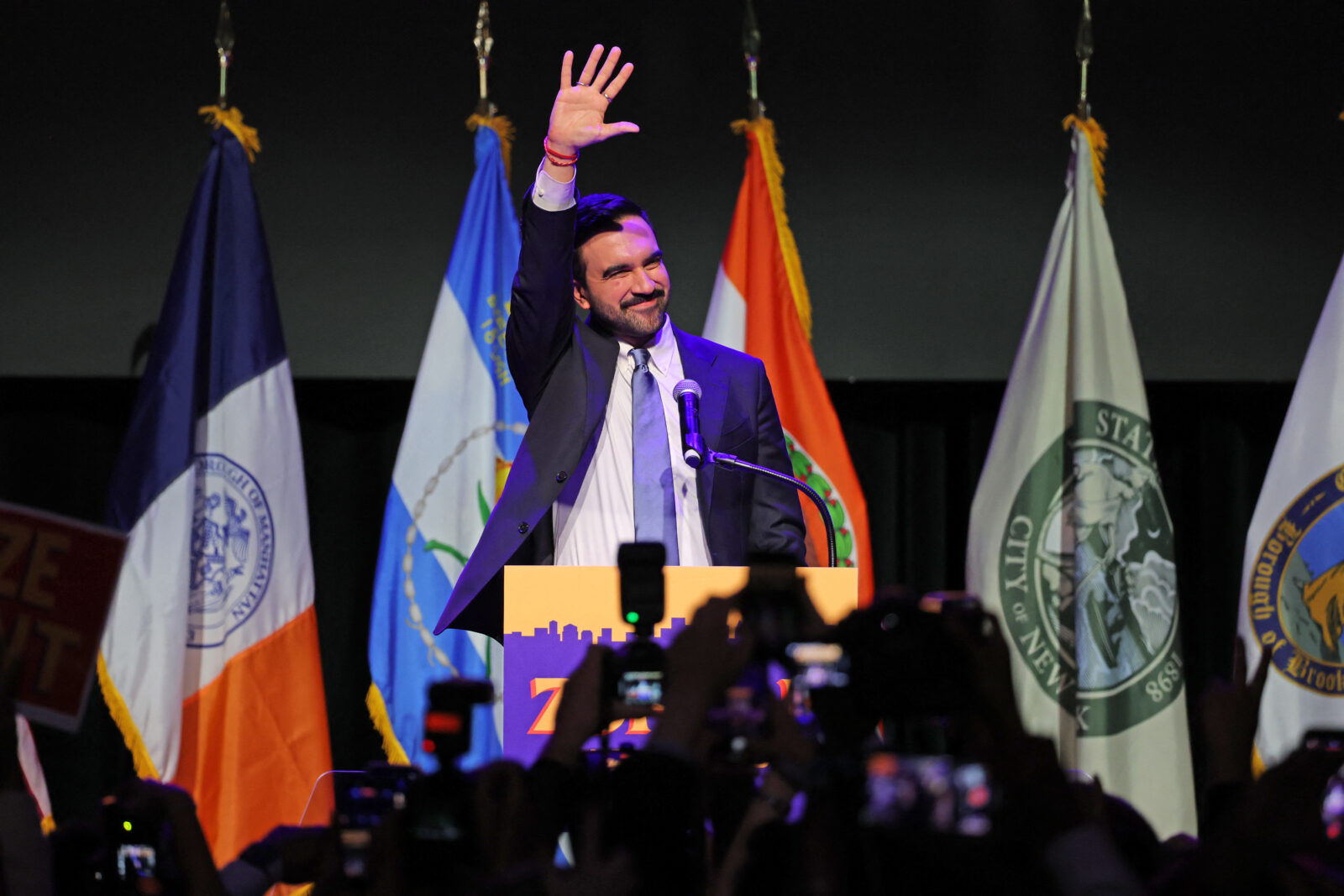
The organized left scored a major victory last week when Zohran Mamdani was elected mayor of New York City, elevating to executive office a politician who became one of the nation’s most prominent democratic socialists during the campaign.
Now, as the movement seeks to ride momentum from Mamdani’s win and grow its influence at the federal level, some emerging challengers are setting their sights on a handful of pro-Israel Democrats in the House — posing what is likely to be the first key test of its political credibility in the upcoming midterm elections.
While next year’s primaries are still more than six months away, some early signs indicate that the far left is already facing obstacles in its efforts to target established incumbents, raising questions about its organizational discipline and messaging ability, not to mention alignment with Mamdani — who is now walking a delicate path in seeking buy-in from state leadership to deliver on his ambitious affordability agenda.
Jake Dilemani, a Democratic consultant in New York, said “there is and should be euphoria among the left” after Mamdani’s victory, “but that does not necessarily translate into toppling relatively popular incumbents.”
“One swallow does not make a summer,” he told Jewish Insider on Tuesday.
In a pair of looming congressional contests in Brooklyn and the Bronx, for instance, potentially divided primary fields are now threatening to split the vote to oppose Reps. Dan Goldman (D-NY) and Ritchie Torres (D-NY), both of whom are preparing to seek reelection amid left-wing backlash over their support for Israel.
Brad Lander, the outgoing comptroller and an ally of Mamdani, has told associates he is planning to challenge Goldman in a progressive district covering parts of Brooklyn and Lower Manhattan, people familiar with his thinking told JI recently.
Lander, who was reportedly boxed out of a top job in Mamdani’s administration over conflict with the mayor-elect, has acknowledged that he is “seriously considering” a House bid, but has yet to confirm his timeline for publicly making a decision. One person familiar with the matter said he is likely to launch a bid after Mamdani assumes office in early January. Lander has denied that there are any tensions with Mamdani or his team.
While polling has shown that Lander would be a formidable challenger to Goldman, thanks to his popularity in the district where he once served as a longtime city councilman, some observers have speculated that he could face skepticism from voters who may see his bid as a consolation after failing to secure a role in City Hall.
Lander and Goldman were seen mingling at some of the same receptions during the Somos conference in San Juan, Puerto Rico, last week, but did not appear to interact.
In addition to Lander, Alexa Avilés, a far-left city councilwoman closely aligned with the Democratic Socialists of America, is also weighing a challenge to Goldman, provoking fears among his critics who say he will benefit from a crowded field that helped him secure a narrow victory in his first House primary in 2022.
Yuh-Line Niou, a former state assemblywoman who placed second in that primary, has been considering another bid as well, sources told JI, after she lost by a margin of just two points in a race that centered in part on her controversial support for the Boycott, Divestment and Sanctions movement.
Goldman, for his part, has sought to downplay the role that Israel could play in the race, arguing that the Trump administration presents a more serious threat to his constituents.
But Avilés, for one, is almost certain to raise Israel in a potential primary challenge, owing to her vocal opposition to the war in Gaza, which she has called a genocide, and outspoken criticism of AIPAC. “The tide is turning, but the forces remain pernicious and persistent,” Avilés said during a panel discussion at Somos last week, warning of “a Congress that is very much controlled by AIPAC.”
“Saying no to violence is not a radical idea,” Avilés added in comments hinting at a challenge. “And you know what, y’all? If people are not stepping up, then we need to remove them.”
In the Bronx, Torres, who is among the staunchest defenders of Israel in the House, has already drawn a primary opponent focusing overwhelmingly on his pro-Israel record and contributions from AIPAC, in an effort to channel the anti-establishment zeitgeist that helped boost Mamdani’s insurgent campaign.
Michael Blake, a former state assemblyman who came in eighth place in the New York City mayoral primary, launched his campaign to unseat Torres last week. But he is facing accusations of hypocrisy over his own previous well-documented ties to AIPAC and past statements voicing strong support for Israel — contributing to a somewhat turbulent rollout that has cast doubts on his viability.
On the sidelines of the Somos retreat last Friday, Blake, who has twice visited Israel and spoken at AIPAC events, insisted that “you can be critical of governmental policies” and it “does not make you antisemitic or anti-Israel.”
Blake, who also ran against Torres in a crowded primary in 2020, said he now supports an arms embargo on Israel, but clarified that, if elected, he would continue to vote for defensive aid for its Iron Dome missile-interception system — views that are unlikely to win converts among voters in Riverdale, a predominantly Jewish Bronx neighborhood where Torres has built a loyal following.
“I do think we have to be attentive of the moment that we’re in right now,” Blake said of his thinking last week, while confirming he would “absolutely” seek support from the DSA, which has so far only endorsed candidates running for state office next year.
Marshall Wittmann, an AIPAC spokesperson, said that the group’s “grassroots members understand the stakes in the upcoming midterms and that is why they are deeply motivated and engaged to help elect pro-Israel candidates and defeat detractors.”
Blake cross-endorsed with Mamdani in the primary and has enthusiastically supported the mayor-elect. But Torres, who once cautioned Mamdani was unfit to lead New York City because of his close ties to the DSA, has since spoken positively about the incoming mayor and praised one of his early appointments as “exceptional” on Monday, complicating the political fault lines in the primary.
A lesser-known primary challenger, Andre Easton, is also campaigning against Torres using similarly hostile rhetoric about Israel and AIPAC. Easton, an independent affiliated with the Party for Socialism and Liberation, has said he is running “to fight for the Bronx — not billionaires who fund genocide in Palestine,” and claims that Torres “pockets money from AIPAC” while children in the district “live in poverty.”
Marshall Wittmann, an AIPAC spokesperson, said that the group’s “grassroots members understand the stakes in the upcoming midterms and that is why they are deeply motivated and engaged to help elect pro-Israel candidates and defeat detractors.”
“The track record demonstrates that being pro-Israel is good policy and good politics as 96% of AIPAC endorsed Democrats won their elections last cycle,” he added in a statement to JI on Tuesday.
Meanwhile, another pro-Israel Democrat, House Minority Leader Hakeem Jeffries (D-NY), is expected to draw a more established far-left primary challenger in the coming weeks, setting up a high-profile fight for the Brooklyn House seat he has held for over a decade.
Chi Ossé, a young city councilman and Mamdani ally who has developed a sizable following on social media, is reportedly planning to seek support from the DSA, as he prepares to launch an insurgent bid to topple Jeffries, long a target of the far left. Ossé recently became a member of the DSA after quitting the group in 2020, he said on social media in 2023, noting that when he first left he “wasn’t aligned with the organization” but that there was “no bad blood.”
Still, he may face resistance from Mamdani, who claimed an endorsement from Jeffries late in the election and is hoping to avoid intraparty conflict while balancing a tenuous coalition to advance his daunting campaign pledges. He has also distanced himself from the DSA’s most extreme positions and said their respective platforms are “not the same.”
“It’s not clear that wins from election night will translate into intra-party primary victories in a midterm election,” Basil Smikle, a professor at Columbia’s School of Professional Studies and a Democratic strategist, said on Tuesday. “There’s a lot of time between now and then but the organizing framework has certainly been established to make a strong run.”
Mamdani, who criticized Jeffries’ pro-Israel views before the mayoral election, had reportedly sought to preempt Ossé’s plans to oppose the congressman who could be the next speaker of the House. As the councilman now moves forward against Mamdani’s apparent wishes, the potential primary battle could place the mayor-elect in an uncomfortable position, possibly fueling tensions with an activist base eager to capitalize on his victory. The DSA did not return a request for comment.
Despite such issues, some experts said that the left remains formidable ahead of next year’s primaries, even as it confronts some potential disorganization.
“It’s not clear that wins from election night will translate into intra-party primary victories in a midterm election,” Basil Smikle, a professor at Columbia’s School of Professional Studies and a Democratic strategist, said on Tuesday. “There’s a lot of time between now and then but the organizing framework has certainly been established to make a strong run.”
Hank Sheinkopf, a veteran Democratic strategist, said that “every pro-Israel Democrat is a target for the newly empowered DSA BDS gang,” and warned that incumbents “should be prepared for a long and costly battle.”