Angel Valentin/Getty Images
Jewish leaders begin outreach to incoming Mamdani administration, sensitively
At the post-election Somos conference, Jewish officials tried to find areas of common ground with the new mayor


 Add JewishInsider on Google
SAN JUAN, Puerto Rico — The humid air was swelling with anticipation as thousands of New York politicos descended on Puerto Rico’s capital last week to attend the annual Somos conference, a multiday marathon of post-election elbow-rubbing where receptions and panels occur alongside covert negotiations and late-night schmoozing at local bars and hotels.
The extended Democratic gathering, which kicked off on Wednesday and continued into the weekend, was adjusting to the ascendant political order led by Zohran Mamdani, whose victory in New York City’s mayoral election earlier that week had upended the Democratic establishment and led to new alliances that until recently would have seemed improbable.
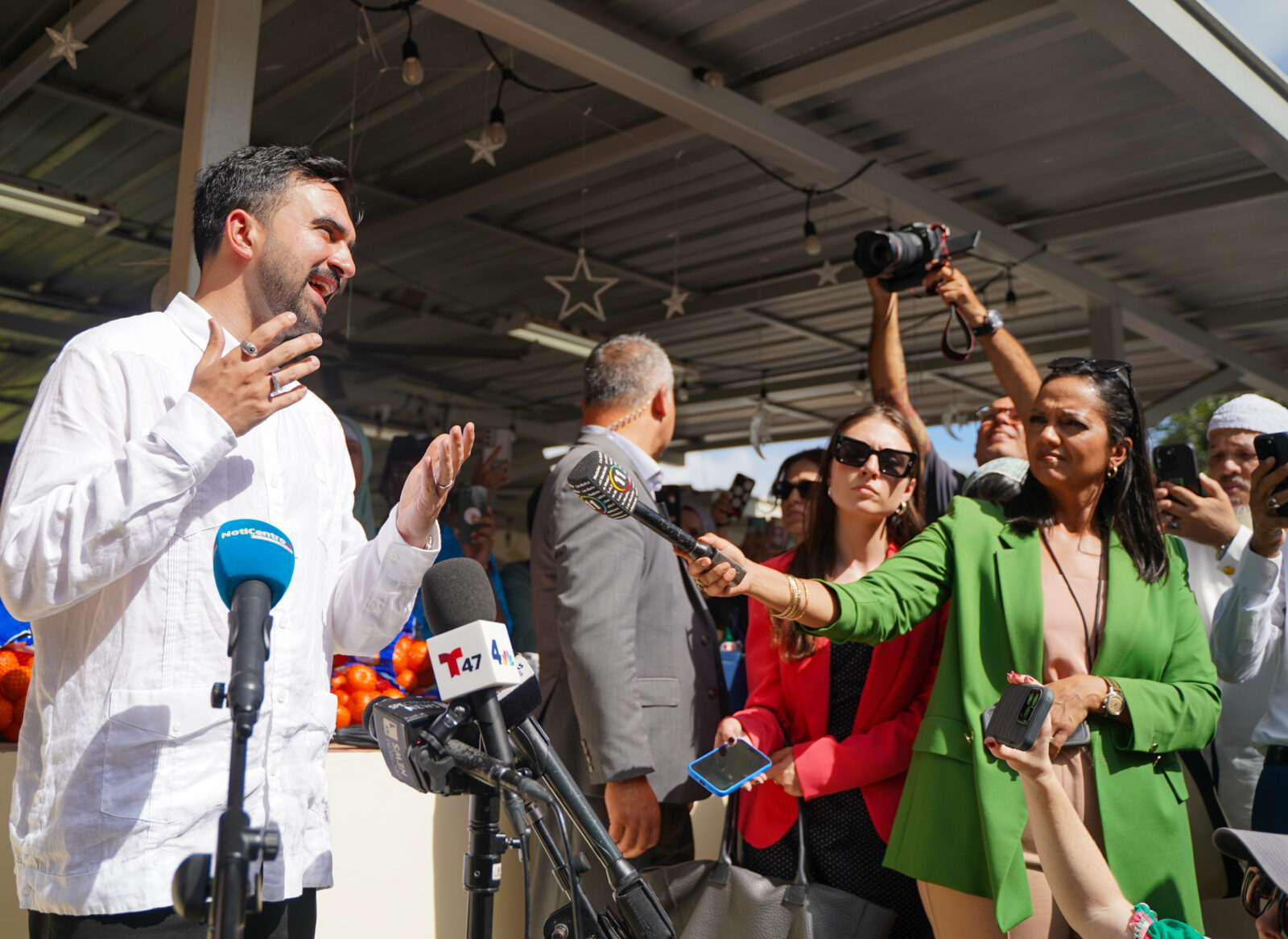
While Mamdani was still largely unknown during Somos last year, just weeks after announcing his long-shot mayoral bid, the 34-year-old democratic socialist and state assemblyman now seized the spotlight as attendees swarmed his arrival Thursday at the Caribe Hilton, where the incoming mayor was later fêted by some of the state’s top elected officials at a crowded beachside reception.
For many Jewish leaders who joined the Caribbean confab, however, the feeling was far more subdued, as they openly grappled with the sensitive question of how to work with a mayor-elect whose stridently anti-Israel views conflict with their own core values.
It is a wholly unfamiliar position for Jewish leaders and mainstream Jewish institutions in New York City, where the mayors have long been proudly pro-Israel. But Mamdani’s stunning rise challenged the conventional thinking that a winning candidate in New York, a place with the largest Jewish community of any city in the world, must show strong support for Israel. In breaking with decades of precedent, Mamdani still faced skepticism from a significant number of Jewish voters who cast their ballots for former New York Gov. Andrew Cuomo, who lost the Democratic primary and then ran as an independent. Exit polls showed that Cuomo, a vocal supporter of Israel, had doubled Mamdani among Jewish New Yorkers, with around two-thirds of the vote.
As Mamdani prepares to assume office in less than two months, Jewish leaders mingling at Somos were freshly processing his looming mayoralty with a mix of shock, hesitation and bemused detachment. Even if some voiced hope for a positive relationship, most were not ready to specify how they planned to move forward or what was expected of his administration.
One well-connected Jewish attendee cited the five stages of grief in characterizing the reactions among Jewish community leaders who had largely resisted engaging with Mamdani’s campaign. Many of them, it seemed, were dealing with the first stage of denial — and were far from finally reaching acceptance.
“We’re so screwed,” one Jewish political activist was overheard lamenting at an event on Friday evening.
Still, some Jewish community leaders who spoke with Jewish Insider over the course of the retreat suggested they were willing to give Mamdani the latitude to follow through on areas where they are aligned, pointing to a sort of provisional detente in the aftermath of a bruising and emotionally fraught election.
“The mainstream Jewish community is open to dealing with reality,” Noam Gilboord, the chief operating and community relations officer at the Jewish Community Relations Council of New York, said diplomatically while attending the conference.
The JCRC, for its part, has not yet held any direct meetings with Mamdani, though members of his team privately reached out about some key issues during the election and have continued to stay in touch, according to Mark Treyger, the group’s chief executive. The campaign gave a heads-up to JCRC leadership, for instance, before Mamdani publicly announced that he would ask Jessica Tisch to stay on as police commissioner, an encouraging choice to Jewish community leaders who favored her for the role.
“We are here to represent the transition with the Jewish community, and we’re so happy to be here,” Ali Najmi, a Mamdani confidante and chief counsel to the mayor-elect’s transition team, told JI in a brief exchange. “We see so many good friends and old friends, and we’re so looking forward to our new friends.”
Mamdani’s team also checked in with the JCRC after he had won the primary to give assurances that the newly anointed Democratic nominee was committed to providing continued security for its annual Israel Day on Fifth parade — even if he was unlikely to attend, as a supporter of the Boycott, Divestment and Sanctions movement against the Jewish state.
While Mamdani was absent from a Thursday night reception the JCRC hosted with the UJA-Federation of New York, he sent two of his top aides, Ali Najmi and Elle Bisgaard-Church, to join the event instead. They were warmly greeted by attendees in a public easing of tensions that would have been difficult to imagine just a few weeks ago.
“We are here to represent the transition with the Jewish community, and we’re so happy to be here,” Najmi, a Mamdani confidante and chief counsel to the mayor-elect’s transition team, told JI in a brief exchange. “We see so many good friends and old friends, and we’re so looking forward to our new friends.”
Najmi did not share further details regarding the transition’s formal plans to address Jewish issues, steps that are certain to be aggressively scrutinized in the coming months.
Yeruchim Silber, the director of New York government relations at Agudath Israel of America, an Orthodox advocacy group, said he appreciated the outreach and looked forward to meeting with Najmi again. “We’re hopeful that we could always find some common ground and work together,” he told JI during the reception. “Look, the mayor-elect said very clearly in his victory speech that he’s going to tackle antisemitism,” he added, “so we’ll take him at his word.”
“My understanding is there is interest in more formal Jewish outreach” from Mamdani’s team, said Phylisa Wisdom, the executive director of New York Jewish Agenda, a liberal Zionist group that has been receptive to the mayor-elect. Wisdom, who joined a private conversation with Mamdani at a Reform synagogue in Brooklyn before the election, said the appearance of his aides at the reception on Thursday demonstrated “a desire to be in all kinds of Jewish spaces they may not have been during the election,” in order to “build relationships and show goodwill.”
“This is a very, very divided time for the city, I think I can acknowledge that,” Mark Levine, the incoming city comptroller who endorsed Mamdani, said in his remarks to the room.
Mamdani, whose presence at formal Somos events drew throngs of eager admirers seeking selfies with the mayor-elect, likewise steered clear of an annual Shabbat gathering convened by the Met Council, the Jewish anti-poverty charity. Despite his victory, the event, which featured Rep. Gregory Meeks (D-NY), New York state Attorney General Letitia James and other prominent officials, made no direct allusion to Mamdani — further highlighting his uncomfortable relationship with the Jewish community.
Instead, the speakers at the Met Council’s widely attended reception zeroed in largely on such issues as hunger, poverty and the Trump administration’s efforts to withhold payments for food stamps amid the government shutdown.
“This is a very, very divided time for the city, I think I can acknowledge that,” Mark Levine, the incoming city comptroller who endorsed Mamdani, said in his remarks to the room.
Levine, who is Jewish, is now facing pressure from some Mamdani allies to divest the city from Israel bonds. He has refused to change course, saying last week that he has “criticism of the Israeli government” but still maintains “deep personal ties to Israel.” Mamdani, meanwhile, has voiced support for ending “the practice of purchasing Israel bonds,” though Levine has indicated he does not believe the mayor-elect has the power to enforce such a policy.
The Shabbat reception was disrupted by anti-Israel protesters two years ago, weeks after Hamas’ Oct. 7, 2023, attacks. But no such demonstrations occurred last Friday.
Mamdani, who will soon become New York City’s first Muslim and South Asian mayor, has frequently vowed to fight rising antisemitism. The day after the election, he swiftly moved to condemn vandalism of a Jewish day school in Brooklyn that was defaced by swastika graffiti, calling the attack a “disgusting and heartbreaking act of antisemitism” and pledging to “always stand steadfast with our Jewish neighbors to root the scourge of antisemitism out of our city.”
In his outreach to different parts of the Jewish community and in his public remarks during the election, Mamdani called for increased funding to prevent hate crimes and boosting police protection at Jewish institutions. He has expressed interest in a city curriculum backed by leading Jewish groups, even as it uses a definition of Zionism contradicting his own views on Israel. Mamdani has said he does not recognize Israel as a Jewish state.
Despite his pledges to counter antisemitism, that tension underscores how many Jewish leaders see his positions as an active threat and an impediment to upholding support for Israel, as the war in Gaza has fueled deep divisions in the Democratic Party.
Mamdani’s anti-Israel stances have provoked concerns that he will act on his views when he takes office. He has indicated, for instance, that he would reassess the partnership between Cornell University and Israel’s Technion, situated on Roosevelt Island. He has also pledged to arrest Israeli Prime Minister Benjamin Netanyahu for war crimes if he steps foot in New York City, in a controversial move that legal experts have questioned as legally dubious.
Mamdani has faced scrutiny for his ties to the Democratic Socialists of America, whose avowedly anti-Zionist mission includes demands that the mayor-elect implement several policies that would sever New York City’s relations with Israel. His refusal to explicitly condemn calls to “globalize the intifada” have otherwise continued to frustrate Jewish community leaders.
Robert Tucker, a Jewish philanthropist who had served as the commissioner of New York City’s Fire Department until last week, announced that he was resigning after Mamdani’s win, reportedly owing to the mayor-elect’s anti-Zionist stances.
But some Jewish leaders at Somos speculated that Mamdani may now see his vocal opposition to Israel as an albatross as he seeks to enact an ambitious affordability plan that will need buy-in from the state leadership.
During his time at Somos, the mayor-elect seemed careful to largely avoid the issue. “I will make clear that we are not looking to remake New York City in my image,” he said in remarks at a labor breakfast Saturday. “We are looking to remake it in the image of struggling workers across the five boroughs.”
In comments to a mosque he visited in San Juan, where the imam had mentioned Palestine during his own sermon, Mamdani spoke in metaphorical terms as he addressed the audience. “If you are not at the table, you may find yourself on the menu,” he noted. “It was a Muslim brother, Malcolm X, who reminded us that sitting at the table does not make you a diner. You have to be eating some of what’s on that plate.”
Still, some of Mamdani’s allies on the far left indicated that they were eager to use momentum from his victory to push a more hostile view of Israel into the mainstream discourse and to challenge incumbents who accept donations from AIPAC while promoting pro-Israel policies.
In a panel discussion on Thursday billed as “Colonialism, Resistance and Solidarity: Puerto Rico and Palestine,” Mamdani’s supporters — including City Councilmember Alexa Avilés, Beth Miller of Jewish Voice for Peace Action and Linda Sarsour, a Palestinian-American activist who has spread antisemitic rhetoric — were emboldened by his recent win, as attendees chanted “From the river to the sea, Palestina will be free!” and “Viva, viva Palestina!” Sarsour described Mamdani’s election as “a new day” and said “we’re not going back.”
“Being someone who supports the Palestinian people is no longer a political liability,” Sarsour, who has vowed to hold Mamdani “accountable” as mayor, told the room. “It is what gets you elected into office.”
In statements following the election, a range of Jewish organizations promised to hold Mamdani responsible for keeping Jews in New York City safe. The mayor-elect’s “victory marks the beginning of a new political chapter for New York, one that many in our community view with enormous concern,” Eric Goldstein, the CEO of the UJA-Federation of New York, said in a letter to supporters. “His rhetoric on Israel and Zionism raises serious questions about whether Jewish New Yorkers will continue to feel seen and protected in the very city we indelibly helped build and grow.”
He said the Jewish community would be watching closely to ensure “that antisemitism is not given any oxygen in our neighborhoods,” adding that “actions matter more” than “words.”
Rabbi Ammiel Hirsh, who leads Stephen Wise Free Synagogue on Manhattan’s Upper West Side, said in a post-election sermon that he “will readily engage in dialogue” with Mamdani if he chooses to reach out. “We will support Mayor Mamdani’s policies where we can — and oppose them when we must,” he concluded.
New York Gov. Kathy Hochul, who, at Somos, celebrated Mamdani’s win, also stressed to reporters on the sidelines of the conference that Jewish New Yorkers still need to “see action” from the mayor-elect to address their concerns. “That’s one area where I know that there’s some opportunities for him to demonstrate, as he has said, but also demonstrate that he is there to protect all New Yorkers, to protect anyone’s right to worship or their beliefs but also their institutions,” she explained.
The Anti-Defamation League, for its part, launched a “Mamdani Monitor” to track policies that could impact Jewish safety and security. Jewish leaders in attendance at Somos, however, voiced reservations with the effort, suggesting they did not see it as productive as some in the community look for common ground to work with the mayor-elect.
Others voiced hope that a leading candidate for City Council speaker, Julie Menin, who is Jewish, would serve as a counterweight to Mamdani — in contrast with a leftist rival, Crystal Hudson, seen more as an ally of the mayor-elect. Menin, who declined to join a meeting between Mamdani and Jewish officials in the primary, is known as an outspoken supporter of Israel in the City Council.
New York Gov. Kathy Hochul, who, at Somos, celebrated Mamdani’s win, also stressed to reporters on the sidelines of the conference that Jewish New Yorkers still need to “see action” from the mayor-elect to address their concerns. “That’s one area where I know that there’s some opportunities for him to demonstrate, as he has said, but also demonstrate that he is there to protect all New Yorkers, to protect anyone’s right to worship or their beliefs but also their institutions,” she explained.
Hochul, for her part, has also drawn backlash from Jewish donors for choosing to back Mamdani’s campaign in the general election, people familiar with the situation told JI. “She’s got a lot to prove,” one Jewish leader said of the governor, long regarded as a staunch defender of Israel.
Rep. Dan Goldman (D-NY), a pro-Israel Jewish Democrat who declined to endorse Mamdani in the general election, told JI at Somos that, despite their disagreements on Israel, he was looking forward to working with the mayor-elect on areas of alignment such as cost of living issues.
But some Jewish community activists were more suspicious of the incoming mayor. One Brooklyn organizer dismissed the possibility of working with Mamdani outright, saying that his stances on Israel had foreclosed any hope of finding common ground, even on unrelated issues.
Leon Goldenberg, an Orthodox business leader in Brooklyn who serves as an executive board member of the Flatbush Jewish Community Coalition, which endorsed Cuomo in the general election, told JI that he has been struggling to decide whether he will ask Mamdani for a meeting.
“I’m really at a loss,” he said on Thursday. “What are we going to talk about, Israel?”
The FJCC itself, which long enjoyed a close relationship with outgoing Mayor Eric Adams, was more optimistic, according to Josh Mehlman, the group’s chairman. “We have met, and will meet with them again,” he said of Mamdani’s team. “We are confident we can work together for the best interest of the Flatbush community and the Orthodox Jewish community citywide.”