Win McNamee/Getty Images
Trump-MBS meeting poised to advance defense pact and F-35 deal as Israel normalization stalls
As Washington and Riyadh prepare for a high-level meeting, experts say a U.S.-Saudi defense pact and fighter jet deal appear imminent — but normalization with Israel remains unlikely


 Add JewishInsider on Google
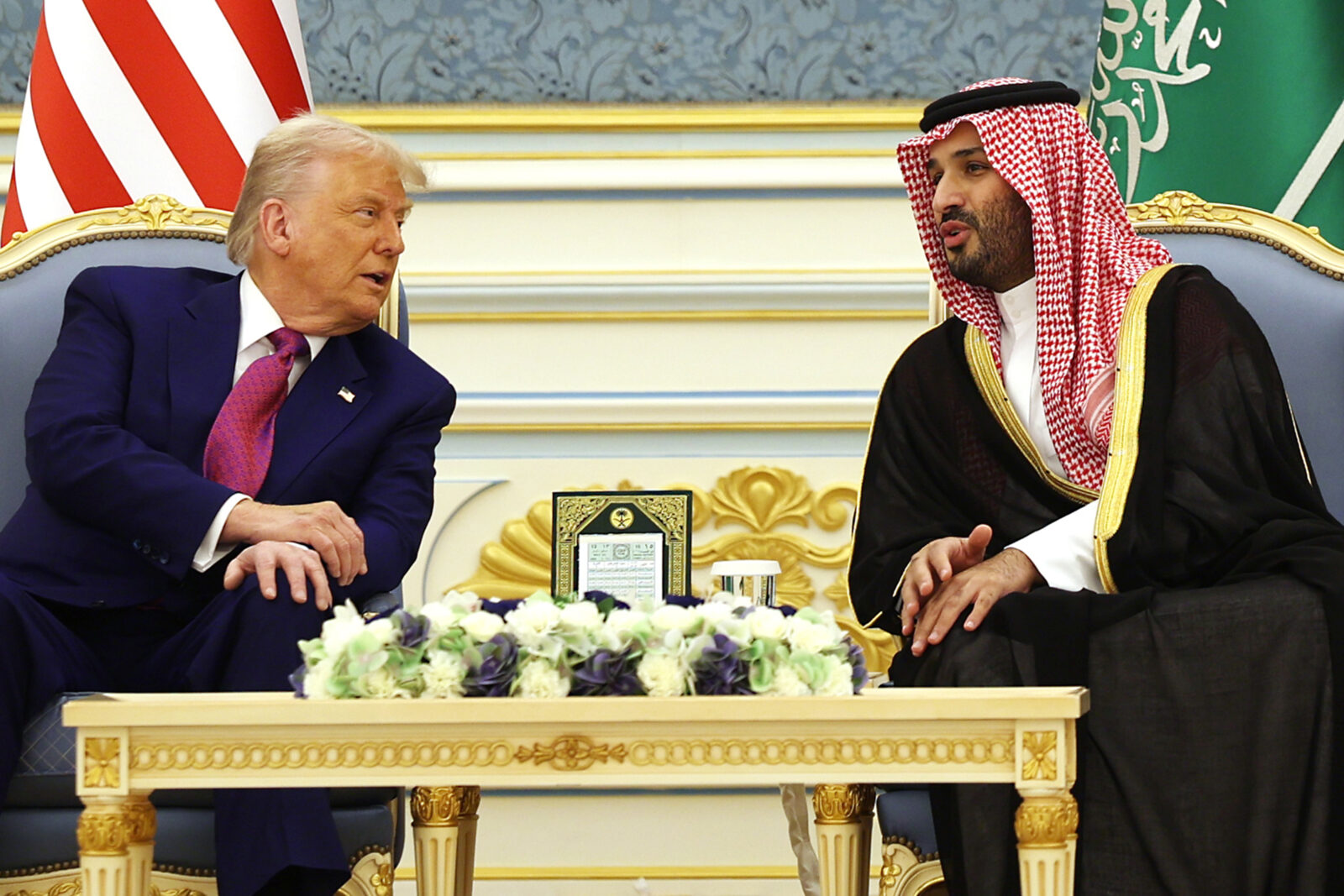
President Donald Trump is slated to meet with Saudi Crown Prince Mohammed bin Salman on Tuesday in a meeting that experts told Jewish Insider is expected to move forward a U.S.-Saudi defense pact and sale of F-35 fighter jets to the kingdom — yet normalization with Israel, once tied to the prospect of such deals, remains elusive.
U.S. and Saudi officials have been holding intense negotiations to finalize a defense agreement ahead of the visit, according to reports. Since an Iranian attack on Saudi oil refineries in 2019, Riyadh has sought to formalize American security guarantees, according to Ghaith al-Omari, a senior fellow at The Washington Institute for Near East Policy.
“Saudi Arabia is an important American security partner,” said Brad Bowman, a senior director at the Foundation for Defense of Democracies. “The United States and Saudi Arabia have been working toward a regional security architecture for years.”
The agreement is expected to be modeled after the assurances Trump gave to Qatar in a September executive order, which stated that the U.S. will regard “any armed attack” on Qatar “as a threat to the peace and security of the United States.”
“Having for better or worse made the commitment to Qatar, it seems to me unfathomable that the administration wouldn’t offer at least the same commitment to Saudi Arabia and probably to other traditional Gulf partners like the UAE who over the years have often been more steadfast and reliable allies in their support for U.S. regional and global objectives,” said John Hannah, a senior fellow at the Jewish Institute for National Security of America.
Al-Omari said such guarantees help to solidify American leadership in the Middle East and “serve to limit Chinese influence in the region.”
“It is almost certain that Saudi Arabia will get defense guarantees in this visit,” said Al-Omari. “Providing such guarantees is the correct policy. The security of Saudi Arabia is an American interest, and is key to deter Iran and its proxies from destabilizing the Kingdom. It also sends a clear message that the U.S. remains committed to its Middle East allies.”
Should the defense agreement be formalized as an executive order, like with the Qatar deal, it will need to be enforced by the next president to remain effective. Bowman argued that any serious agreement should instead go through the appropriate process even if it takes time.
“[The security deal] is essentially a treaty that should go through the U.S. Senate,” said Bowman. “That’s not going to be quick, but if we really believe what we’re saying about the value of Saudi Arabia as a security partner … then why not take the time and build consensus and explain that to the American people and their representatives on Capitol Hill and make the case?”
Hannah said that a more formal defense pact is also in Saudi Arabia’s best interest.
“The problem for the Saudis is that until recently, they were holding out for an actual Senate-approved defense treaty that would have made the U.S. commitment to the Kingdom’s future wellbeing a bipartisan and permanent feature of the American foreign policy landscape rather than the temporary pledge of a polarizing, mercurial, and increasingly unpopular president who will be gone in three years time,” said Hannah. “That’s a pretty public climb down and trimming of ambitions from the kind of history-making agreement and lasting transformation of U.S.-Saudi ties that MBS has been insisting that he needed for the past three years.”
“It is likely that an announcement about the F-35s will be made,” said Ghaith al-Omari, a senior fellow at The Washington Institute for Near East Policy. “However, turning such an announcement into reality will have to contend with a number of challenges — whether the legal requirement to maintain Israel’s [qualitative military edge is met], or other congressional processes required to finalize such a deal.”
Riyadh is also reportedly seeking to purchase a weapons package from the U.S. that would include F-35 fighter jets. If agreed upon, Saudi Arabia would become the first nation in the Middle East other than Israel to procure it.
The Trump administration has been open to such a deal this year, but questions still remain regarding the impact such an agreement might have, including on Israel’s qualitative military edge, which the U.S. is bound by law to uphold.
“It is likely that an announcement about the F-35s will be made,” said Al-Omari. “However, turning such an announcement into reality will have to contend with a number of challenges — whether the legal requirement to maintain Israel’s [qualitative military edge is met], or other congressional processes required to finalize such a deal.”
Israeli Ambassador to the U.S. Yechiel Leiter said in an interview published on Thursday by The Jerusalem Post that Israel “prefer[s] that Turkey not receive F-35 [fighter jet]s from the U.S.” but said that “there’s no indication that Israel’s qualitative edge will be compromised” if Saudi Arabia were to acquire them.
The potential F-35 deal has also prompted concern on the risks of transferring sensitive technology to Riyadh while it cooperates militarily with China, a key U.S. adversary.
“Guess what the Saudi military forces did last month? Last month, Saudi naval forces conducted a military exercise with China,” said Bowman. “That’s not a good look for a country. That’s not going to sit well with a lot of folks on Capitol Hill.”
Bowman said that in the past, Saudi Arabia has suggested they would turn to Beijing if they couldn’t get “what they wanted” militarily from the U.S.
Should the Trump administration formally approve the sale, it is required by law to be submitted to Congress where there is first a non-statutory, but normally respected, review process that involves leaders of the two foreign relations committees. However, it is highly unlikely for the sale to be stopped even if lawmakers disapprove, once the administration decides to formally submit the sale to Congress.
“The law provides a mechanism for Congress to try to stop an arms sale up to the point of delivery, but that requires both chambers to pass joint resolutions of disapproval and then overcome a prospective presidential veto,” said Bowman. “The Congressional Research Service noted last year that Congress has never blocked a proposed arms sale this way.”
While the Biden administration had tied such security deals to progress on normalization, Al-Omari said that the Trump White House has “abandoned this approach.”
“I think it would be folly not to insist that the ultimate integration of these planes into the Saudi order of battle be tied to normalization and a more fundamental and permanent transformation in Saudi-Israel relations and the regional security landscape,” said Hannah.
Bowman agreed, “The F-35, to me, provides valuable leverage in getting Riyadh to recognize the world’s only majority Jewish state. Forfeiting that leverage would be unwise. I can’t imagine giving our nation’s most advanced fighter jet to a country that refuses to normalize relations with our best ally in the Middle East.”
While experts believe Trump is unlikely to push normalization in the upcoming meeting, they say it is still something the Trump administration is pursuing.
“The price for MBS clearly has gone up after two years of devastation in Gaza — and more important, two years of non-stop 24/7 coverage in Arab media of Palestinian suffering and carnage,” said John Hannah, a senior fellow at the Jewish Institute for National Security of America. “MBS knows how significant his entry into the Middle East peace club will be for regional and global politics and he seems set on delivering something significant in exchange.”
“President Trump is still committed to pushing forward Saudi-Israeli normalization,” said Al-Omari. “Yet he is also aware that the gap between the two countries at the moment is too wide to bridge.”
Saudi officials have said they require an Israeli commitment to a two-state solution as a prerequisite to normalizing ties. Hannah said that he does not expect progress towards normalization during the trip, also adding that in the wake of the war in Gaza, Riyadh may be looking to gain more concessions before formally entering a peace agreement.
“The price for MBS clearly has gone up after two years of devastation in Gaza — and more important, two years of non-stop 24/7 coverage in Arab media of Palestinian suffering and carnage. MBS knows how significant his entry into the Middle East peace club will be for regional and global politics and he seems set on delivering something significant in exchange.”
“I wouldn’t rule out that Trump might be willing during the visit to show greater openness and even U.S. support for the eventual establishment of a Palestinian state along lines articulated by [MBS] in an effort to inch him along a little faster on normalization,” Hannah added. “Trump’s pressure and powers of persuasion, and his ability to offer other economic and military incentives to [MBS], also might help temper the crown prince’s demands and ambitions at the margins if the side payments are significant enough.”
Still, Al-Omari believes there are other ways the Trump administration could utilize the upcoming meeting to gain progress towards this goal.
“Instead, the U.S. should explore areas of economic cooperation between the two countries,” said Al-Omari. “That may fall short of full normalization, but would lay the groundwork for future progress.”