Prime Minister's Spokesperson's Office
Netanyahu’s nominee to lead Mossad is his close advisor and an IDF general who fought the system
Roman Gofman’s supporters tout him as an Israeli patriot and Oct. 7 hero; his detractors say he’s unfamiliar with the agency


 Add JewishInsider on Google
Israeli Prime Minister Benjamin Netanyahu’s announcement earlier this month that his military secretary, Maj.-Gen. Roman Gofman, would become head of the Mossad, came as a surprise to the public, as journalists and experts had been confident that current Mossad chief David Barnea’s deputy, known only as “A,” had the job in all but name.
However, for those who know Gofman, his time in the IDF and his working relationship with Netanyahu, as well as the prime minister’s post-Oct. 7 predilection for bringing in outside candidates to take over defense institutions, Gofman was a natural choice.
Netanyahu appeared on Sunday before the committee that will determine whether Gofman’s appointment is finalized, and IDF Chief of Staff Eyal Zamir and Gofman himself are expected to speak to the committee this week. Should the committee approve Gofman, he will enter the role in June.
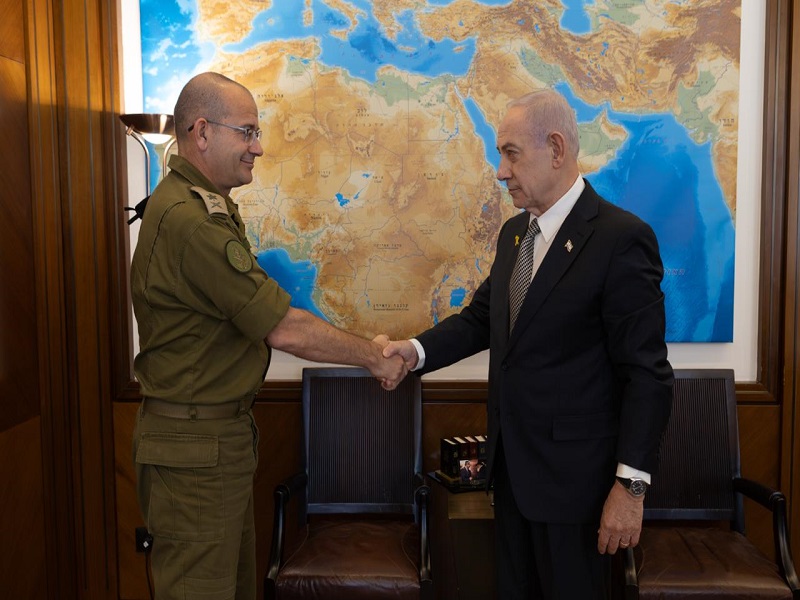
Gofman has a limited public profile as Netanyahu’s senior military advisor. But in Israel, his face is fairly familiar, as he can be seen walking behind Netanyahu into the Oval Office and other high-level meetings, even as military secretaries don’t make public statements.
Gofman, 49, was born in Belarus, then part of the Soviet Union, and immigrated to Israel with his family at the age of 14. He was bullied in school and took up boxing to fight back, becoming the second-ranked young boxer in Israel in his weight category. He enlisted in the IDF Armored Corps in 1995 and has been in the military ever since, rising to the rank of Aluf, or major general.
In October 2022, Gofman was appointed commander of the National Center for Ground Training. A year later, when Hamas invaded southern Israel, Gofman drove from his home in Ashdod towards the Gaza border, without a bulletproof vest or a helmet. He took on Hamas terrorists at the Sha’ar HaNegev Junction, killing two and sustaining a severe wound to his knee, after which he found Israeli police officers nearby who took him to the hospital. In his first public remarks after the battle, he said: “We failed. … Now we’ll go forward and kill them all.”
Netanyahu chose Gofman as his military secretary in 2024, and he became one of the prime minister’s closest and most trusted advisors. As such, Gofman was a central figure in Israel’s decision to work with the Gaza Humanitarian Foundation to distribute food to civilians in Gaza, among other high-level moves.
Netanyahu has sent Gofman on multiple trips to Moscow for discussions on security matters, following the fall of former Syrian leader Bashar al-Assad, and Gofman is said to have played a key role in shaping Israel’s policies relating to Syria since then.
Maj.-Gen. (res.) Gershon Hacohen, who knows Gofman well from their years in the IDF, told Jewish Insider that “Gofman did what no military secretary has done in history. … Thanks to Roman, [Netanyahu] made significant decisions in running the war and … circumvent[ed] a system that sometimes leaves out the prime minister.”
Gofman, Hacohen said, “has strategic vision. Syria came as a surprise, and he had a decisive role in the decision [for the IDF] to go in.”
Hacohen said that Gofman’s background, as an immigrant from the former Soviet Union, is an advantage: “He knows that America is not the whole world and there are other forces we need to talk to and understand in depth.”
Several of Gofman’s current and former colleagues spoke to JI about the new appointee on condition of anonymity. They painted a picture of a passionate Israeli patriot who is well-read and informed on military history and international affairs, while being pragmatic and able to translate that knowledge into an operational approach. They said that Gofman is creative and takes initiative, but is also a good listener, who is willing to accept criticism and alternatives to his own ideas.
In the prime minister’s announcement of Gofman’s appointment as head of the Mossad, Netanyahu called him “an officer of great merit,” and praised his “significant involvement in the seven theaters of the war,” – meaning Gaza, Lebanon, the West Bank, Syria, Iraq, Yemen and Iran – as well as his work with all intelligence and security services, including the Mossad.
“Maj.-Gen. Gofman has demonstrated creativity, initiative, stratagem, deep recognition of the enemy, absolute discretion, and the safeguarding of secrets,” the statement from the Prime Minister’s Office reads. “These qualities, as well as his leadership and courage, were evident at the outbreak of the War of Redemption, when he rushed from his home and fought in person against Hamas terrorists in the Western Negev, where he was severely wounded.”
Following the announcement, critics of Netanyahu — mostly in the media, not in the Knesset — made the argument that Gofman does not have the experience in intelligence to head the Mossad.
Prominent left-wing activist and pundit Yariv Oppenheimer, a former leader of Peace Now, was one of many who argued that Gofman’s close relationship with Netanyahu made him suspect.
“I don’t know this general … but I care about the big picture, which is that Netanyahu is treating this country like it’s his personal property. He wants a Mossad chief who is loyal to him before the country,” Oppenheimer said on a panel on Israeli public broadcaster Kan. “This is an unnatural appointment, and when something is not natural, it raises questions.”
Hacohen rejected the argument that Gofman is “loyal to the king and not the kingdom. It’s nonsense, because the king is the kingdom. They go together.”
Historically, some of the Mossad’s best-known leaders came from outside the organization, including Meir Amit, Zvi Zamir and Meir Dagan, the latter of whom not only came from outside the Mossad, but was a leading figure in former Prime Minister Ariel Sharon’s 2001 election campaign. Hacohen noted that the “the best intelligence agency in the world, the MI6,” also often has leaders recruited from outside the organization.
Hacohen also argued that Gofman learned “unique and significant” things about Israel’s broader security picture as Netanyahu’s military secretary, including the role of the Mossad, and that the job of the head of the Mossad is to “connect people with micro-experience, while seeing the macro.”
Sources who worked with Gofman have cited his creativity and his willingness to stand up to his superiors and against conventional wisdom. Hacohen said that Gofman “challenged the system everywhere he went. … He had the ambition and desire to ask questions and do better.”
In 2019, Gofman argued for greater deployment of IDF ground forces in sensitive arenas, which, six years later, was one of the conclusions the IDF drew following the Oct. 7, 2023, Hamas attacks on Israel. His remarks were made at a conference of IDF officers with departing Chief of Staff Gadi Eisenkot, now a Knesset member. In footage of his remarks, Herzi Halevi and Aharon Haliva, who served as IDF chief of staff and head of intelligence, respectively, on Oct. 7, can be seen in the audience.
“We are ready to fight, but there is one problem,” Gofman said at the time. “You are not using us. Over time a very problematic pattern has developed, which is essentially the avoidance of using ground forces. And still, in the current reality, we have a lot to offer in the Gaza Strip, Lebanon and Syria … Time after time, [the IDF tells] people we have more relevant tools [than ground troops].”
Gofman’s critics also cite an incident from his time as commander of the IDF’s 210th “Bashan” Division, which is responsible for the front with Syria, that may be especially relevant in his new position as head of the Mossad, as it pertains to his treatment of spies.
Gofman authorized intelligence officers under his command to enlist then-17-year-old Ori Elmakayes, who was fluent in Arabic and ran a Telegram channel and other social media pages with news about the Arab world. The intelligence officers sent him classified information to publish online in an attempted influence operation, even though Gofman and the Bashan Division were not authorized to engage in psychological warfare.
Elmakayes was arrested by Israeli authorities in 2022 for publishing classified information and jailed for nearly two years, after which the indictment was dropped when the investigation found that the intelligence officers were working with Gofman’s approval.
After Gofman’s appointment as head of the Mossad was announced, Elmakayes posted on X that “Gofman abandoned me after initiating an operation in which I was used … Following his abandonment, I was falsely imprisoned … After he used me and ruined my life, Roman Gofman had no problem distancing himself from me despite knowing what I experienced. Such a person cannot be the head of the Mossad. If he abandoned me, what will stop him from abandoning Mossad agents if God forbid they get in trouble in different operations?”
The same year that he launched the influence operation with Elmakayes, Gofman wrote a paper for an IDF journal stating that commanders can act beyond their formal authority to enact the will of policymakers, citing the work of the contemporary Marxist philosopher Slavoj Žižek.
Another controversial paper by Gofman came to light after he was appointed Mossad chief: In 2019, he suggested in a paper for the IDF-run Israel National Defense College — where he received a master’s degree in political science and national security in cooperation with Haifa University — that, should Iran get too close to developing nuclear weapons, Israel should threaten to sell nuclear weapons to neighboring countries, such as Egypt, Saudi Arabia and Turkey, to balance the region.
Gofman leads an outwardly secular lifestyle, but after growing up in the Soviet Union, he sought an education in Judaism and Zionism as an adult.
Gofman told Ynet military reporter Yossi Yehoshua that when he was in the IDF officers’ course, Gofman realized he did not know Israel’s national anthem, “Hatikva,” by heart. “I started to feel like I had no depth in the Zionist, Israeli subject, that there are a lot of things the soldiers could ask and I won’t know how to explain. … It shook me. I was going to be an IDF officer and I was missing so much. I was carrying this vacuum since my aliyah.”
During his undergraduate studies, Gofman also began studying at the Bnei David Pre-Military Academy in Eli, the flagship religious-Zionist institution, for a year of Torah study between completing high school and starting IDF service, many of whose alumni have climbed the IDF ranks.
“They accepted me as I was, without a kippah,” Gofman recalled. “I built a curriculum and came to study one day a week about Zionism, Israel, history, to explain to myself, first and foremost, who I am and what I am.”
“Only then did I suddenly feel that I have two feet on the ground, but a head in the sky. I know how to explain the Zionist idea,” he said.
A former colleague of Gofman said that he is “very well-connected to his roots, because he went through a personal process to connect to them. He knows how to make war, but he also knows what it’s for, the deeper ideology behind it.”
“To fight for Israel,” Hacohen said of Gofman’s search for meaning in his Judaism, “you need faith. We, in the Land of Israel, have many struggles. If those who came from the former Soviet Union were looking for a safe place, why would they come here? This is not just a place for fun or safety, it’s for the liberation of the Jewish people.”