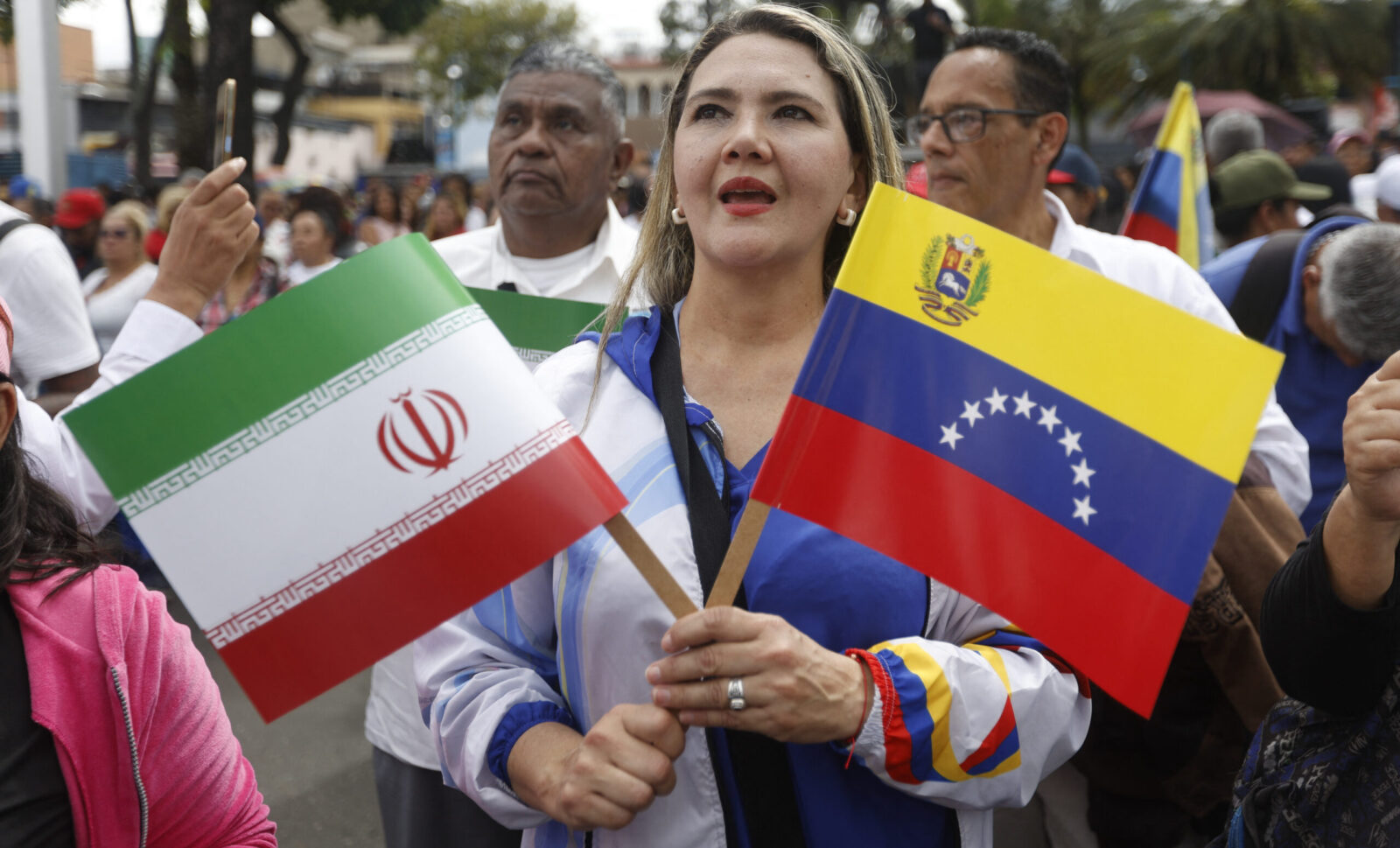
PEDRO MATTEY/AFP via Getty Images
Toppling Maduro may weaken Iran’s hold in Latin America
Caracas served as the hub of Tehran's operations in the Western Hemisphere


 Add JewishInsider on Google
The U.S.’ capture of Venezuelan President Nicolas Maduro on Saturday is expected to weaken Iran’s terrorism efforts, weapons production and economic activity in Latin America, experts say.
With Vice President Delcy Rodriguez taking power — and the Trump administration expressing willingness to work with her — it remains unclear whether Maduro’s regime will largely remain intact with American supervision or if the government will ultimately be replaced by the democratic opposition, led by Nobel Peace Prize recipient Maria Corina Machado, or someone else.
While Venezuela’s future remains unclear, Israel’s leaders applauded what they saw as a pro-American turn, with Prime Minister Benjamin Netanyahu expressing support for the Trump administration’s “determined decision and action of the United States to restore freedom and justice to that part of the world.”
“Across Latin America right now, we are seeing a transformation,” Netanyahu said. “Several countries are returning to the American axis and, not surprisingly, to a connection with the State of Israel. We welcome this.”
Emmanuele Ottolenghi, senior research fellow at the Center for Research on Terror Financing, told Jewish Insider that “if the regime remains in place [under Washington’s supervision], there will have to be adjustments in its regional posture and foreign policy. That means, of course, the role that nefarious foreign actors such as China, Russia, Cuba and Iran played in Venezuela will change.”
Danny Citrinowicz, a senior researcher at the Institute for National Security Studies at Tel Aviv University, told JI that “the Iranians turned Venezuela into a strategic hub, and now that has disappeared.”
“Iran built a very deep operative and strategic relationship with [Maduro’s predecessor Hugo] Chavez, and it uses Venezuela … as its jumping-off point for influence in Latin America,” he said.
Ottolenghi said that Maduro’s government allowed Iran to operate freely in Venezuela, which Tehran took advantage of in a variety of arenas, including propaganda, terrorism and arms manufacturing.
Tehran established a drone factory in Venezuela, in which Venezuelans produced Iranian drones, Ottolenghi said.
The recently foiled terrorist plot to assassinate Israel’s ambassador to Mexico was planned by Iranian operatives in Caracas, Ottolenghi added.
“The Iranians made Caracas the hub of all their propaganda and soft power operations in the region, including their Spanish-language 24/7 news network,” Ottolenghi said. “They established a permanent presence in Caracas for their missionary network, under the umbrella of the sanctioned Al-Mustafa International University.”
After former Iranian President Ebrahim Raisi visited Caracas in 2023, scientific and academic exchanges between the countries grew, and Iran was granted greater access to Venezuela’s economy.
The economic relationship with Venezuela has been important for Iran, Ottolenghi said.
“Venezuela assisted Iran in evading sanctions prior to the JCPOA [2015 Iranian nuclear deal], but since 2019-2020, when the Venezuelan economy sharply deteriorated, Iran gained the upper hand in the relationship,” he said. “Maduro essentially joined the ‘axis of resistance.’”
The country with the largest proven oil reserves in the world needed to buy refined gasoline from Iran because of “the dramatic deterioration in quality in the oil industry in Venezuela after years of cronyism, brain drain, corruption and mismanagement purging the national oil company,” Ottolenghi explained. “The Iranians stepped in to stop Venezuela from collapsing for lack of refined [oil] products, providing technicians, technology, refined gasoline shipped from Iran in exchange for gold. That gave [Iran] even more leverage inside Venezuela, including the ability to operate one of the refineries for their own needs.”
As for Hezbollah, Citrinowicz noted that the Lebanese terrorist organization is “very important to [Iran], in that it connects the Shi’ite communities in Latin America.”
Ottolenghi said that Hezbollah “benefitted from both the protection of the regime and the large expat community of Lebanese immigrants and their descendants … who are sympathetic to the movement and enabled them to become involved in money laundering and other financial activities … including crypto and reportedly illegal gold mining in the southeast of the country.”
Though Hezbollah is an Iranian proxy, it has independent sources of income, including the Latin American drug trade.
Maduro’s fall “will make it hard [for Hezbollah] to keep up those ties,” Citrinowicz said.
Ottolenghi said that “traditionally, [Hezbollah] has played mainly the role of intermediary for drug cartels, providing services in logistics, distribution and financial channels to move the money in complex translational transactions.”
However, he noted that, as opposed to Tehran, Hezbollah’s operations in Latin America have not been primarily based in Venezuela, and that until recently, the terrorist group’s senior official in Latin America was based in São Paolo, Brazil.
“Insofar as Maduro’s removal may curb Iran’s influence and its proxies in Venezuela, it does not address necessarily what Hezbollah is doing in other countries,” Ottolenghi said.
Maduro’s fall is one of “a series of blows” to Iran in recent years, Citrinowicz said, with the governments of Bolivia, Chile and Argentina turning more pro-American, and the same is likely to happen in Colombia in its upcoming presidential election.
“Iran likes working with socialist regimes that counter the West,” Citrinowicz said. “They can’t leave Latin America entirely. … They will need to work with what’s left and emphasize Cuba and Nicaragua.”
Citrinowicz said that Iran will likely pivot its investments of time and money to Africa.