Julie Menin/X
New York Jewish leaders hope Menin will serve as check against Mamdani
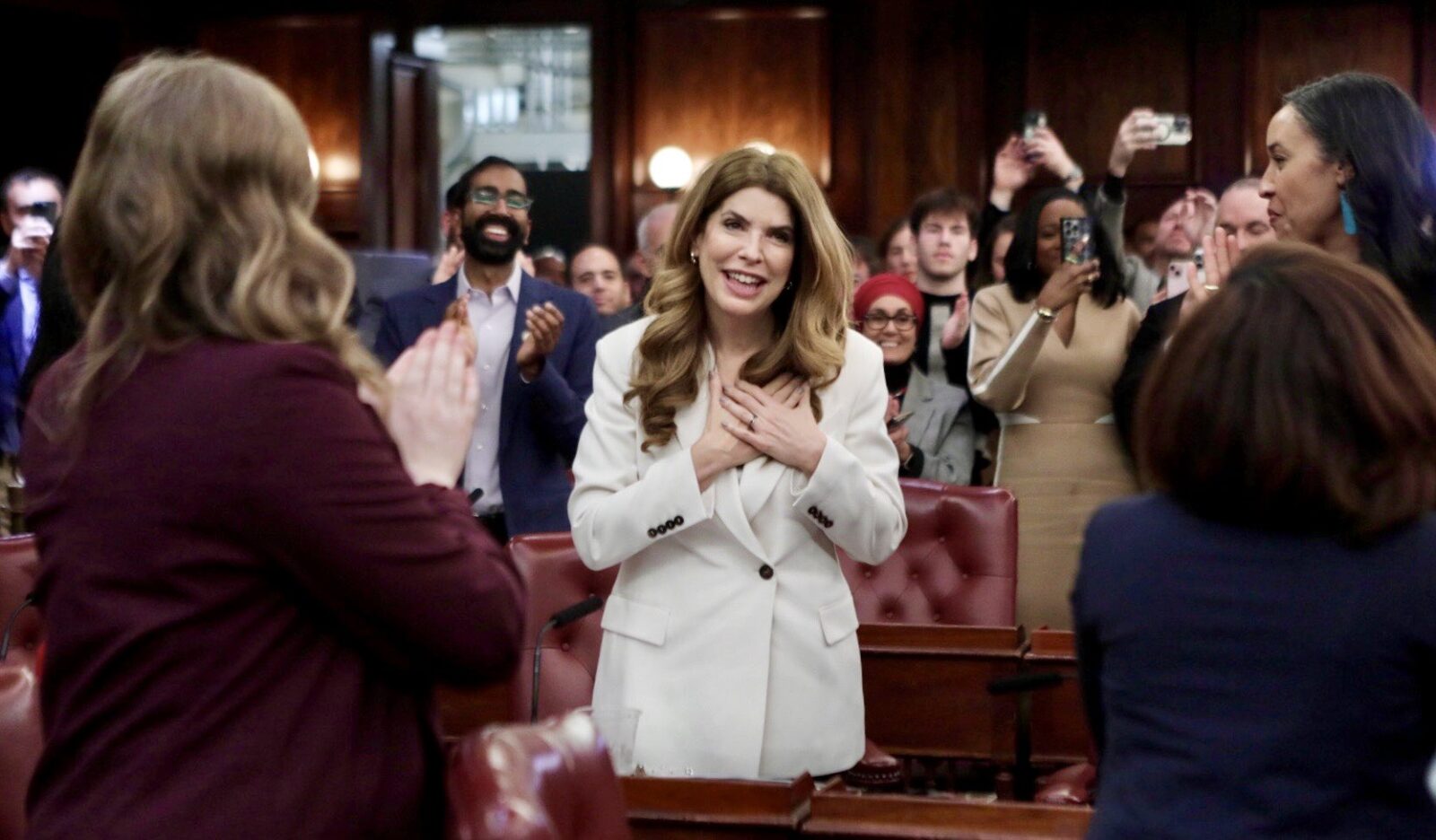
Julie Menin was elected the first Jewish speaker of the New York City Council on Wednesday


 Add JewishInsider on Google
Julie Menin’s election on Wednesday as speaker of the New York City Council was a reassuring sign to Jewish leaders who have long seen the 58-year-old centrist Democrat as a key ally and believe that she will act as a check on Mayor Zohran Mamdani with regard to issues involving Israel and antisemitism.
In a unanimous vote, Menin, a pro-Israel lawmaker and veteran city official who lives on the Upper East Side, became the council’s first Jewish speaker, pledging in her victory speech to focus on “dissolving division” and to “calm tensions” as she prepares to work with a mayor whose hostile views on Israel have long been a defining characteristic of his political ascendance.
“We live in a day with the first Muslim mayor of New York City and now the first Jewish speaker of the council serving at the same time,” Menin said on Wednesday.
Despite the positive tone, Menin, who as speaker now holds the second-most powerful elected role in city government, is still facing the looming prospect of conflict with Mamdani over their differing stances on Israel, which has already animated their nascent relationship.
In her speech, Menin alluded to some tensions that could stoke divisions, insisting that “we must never jeopardize a New Yorker’s right to worship.”
“Because we cannot let what happened outside Park East Synagogue ever happen again, at any house of worship,” Menin said, referring to a protest outside a Manhattan synagogue in November that targeted an event about immigration to Israel and featured chants including “death to the IDF” and “globalize the intifada,” a slogan that Mamdani has refused to condemn.
Mamdani had faced intense criticism after he had admonished the synagogue for promoting what he called “activities in violation of international law,” a statement he later revised.
More recently, after Mamdani had repealed a pair of executive orders tied to Israel and antisemitism on his first day in office last week, Menin said in an interview with The New York Post that she called the mayor to voice her concerns, noting there will “obviously be continued conversation around this.”
Menin added in a separate interview with The New York Times published on Wednesday that she had a “productive conversation” with Mamdani regarding his decision to rescind an executive order issued by former Mayor Eric Adams that adopted a working definition of antisemitism used by the International Holocaust Remembrance Alliance, which labels some criticism of Israel as antisemitic.
While Mamdani indicated during the election that he would seek to invalidate the order, the move triggered widespread backlash from Jewish leaders who said it raised questions over his commitment to effectively fighting antisemitism.
Menin, for her part, telegraphed a more diplomatic position to the Times, even as she had said she was “extremely concerned” by the repeals. “It’s one tool that can be utilized,” she said of the definition. “It’s obviously not the only tool.”
Her assessment underscores what Jewish leaders close to Menin characterized as an even-keeled and largely unflappable approach to governance, which could now be tested on issues she has described as intensely personal.
Menin, a daughter and granddaughter of Holocaust survivors, has long warned of rising antisemitism in New York and has advocated for increased funding to help promote Holocaust education. Menin visited Israel during a solidarity trip after the Hamas terror attacks of Oct. 7, 2023 — after which she introduced a program to send eighth graders to the Museum of Jewish Heritage to raise awareness about the global history of antisemitism.
Chris Coffey, a Democratic strategist who has served as an informal advisor to Menin, said she is “results-oriented and not focused on labels,” while predicting “she will work with the mayor when she can.”
“There may be times when they don’t agree and they will work through it,” he told Jewish Insider earlier this week, saying Menin is “more interested in results than drama.”
Yeruchim Silber, director of New York government relations at Agudath Israel of America, an Orthodox advocacy group, said that Menin “has a long history of working with the Jewish community,” calling her “an important part of the [former New York Mayor Bill] de Blasio administration,” when she led efforts to promote participation in the 2020 census.
He told JI he was “confident she will be able to work collaboratively with” Mamdani’s administration “on all issues important to the community.”
Still, other related issues could emerge as a more challenging test, as Jewish leaders speculate about what actions Mamdani will take next. One point of major tension stems from the partnership between Cornell University and Israel’s Technion, which the mayor’s team had indicated during the election that he would reassess.
Menin, a staunch opponent of Israel boycotts, has praised the joint Cornell Tech campus on Roosevelt Island, which sits in her district, as a crucial hub for local tech and business innovation. “That is an area, of course, of disagreement,” Menin said last month regarding Mamdani’s skepticism of the partnership.
A spokesperson for Menin did not respond to a request for comment from JI on her differences with the mayor.
Menin and Mamdani have in recent weeks largely struck a collaborative tone, appearing at their first joint press conference on Monday to sign executive orders to counter deceptive business practices such as junk fees. Menin has emphasized a shared focus on affordability goals including universal daycare, a key priority of Mamdani’s fledgling administration.
But their courteous public relationship belies other underlying tensions. For his part, Mamdani — who never formally voiced a preference in the contest for council speaker — had privately sought to thwart Menin’s effort as she consolidated backing from a range of members and locked up a supermajority several weeks before the Jan. 1 inauguration. Last month, in a notable snub, Mamdani also did not include Menin in a group of more than 100 elected officials he picked to advise his transition.
Menin, meanwhile, declined to endorse Mamdani, and during the primary chose not to join a summer meeting he had arranged with local Jewish elected officials to address their concerns about his critical views on Israel.
Now that they are working together, some Jewish allies of Menin said they expect that she will put her differences with Mamdani aside, unless provoked to take action with regard to key issues on which she is not aligned with the mayor.
One Jewish leader close to Menin, who asked to remain anonymous to speak candidly, said the new speaker “will be willing to partner with” Mamdani’s administration “to improve the city,” but suggested that it is in the mayor’s “hands to stop doing actions that isolate and antagonize the Jewish community.”
“She is definitely of a mindset of wanting to work together but doing what he did on inauguration day was definitely viewed as a first punch,” the Jewish leader told JI, referring to the executive orders that Mamdani revoked.
Jake Dilemani, a Democratic consultant who served as an informal advisor to Menin in her 2021 Council bid, said that the speaker “is focused on governance and delivering results, and has a strong track record on affordability and consumer protection issues.”
“So, the expectation is this will be a cornerstone of her speakership and that she will work with Mayor Mamdani to put points on the board,” he told JI. “She equally has a strong record on Jewish issues and fighting antisemitism, and it is something that is very personal for her. I fully expect that she will work productively with the mayor on many issues, but will stand up to the administration should she deem it necessary.”