Michael M. Santiago/Getty Images
Mamdani’s antisemitism strategy: Reluctant to confront extremist threats while pledging to protect Jews
The mayor’s comments responding to pro-Hamas protesters in Queens and an arson attack on a synagogue in Jackson, Miss., illustrate what Mamdani’s critics interpret as a core tension animating his assessment of antisemitism


 Add JewishInsider on Google
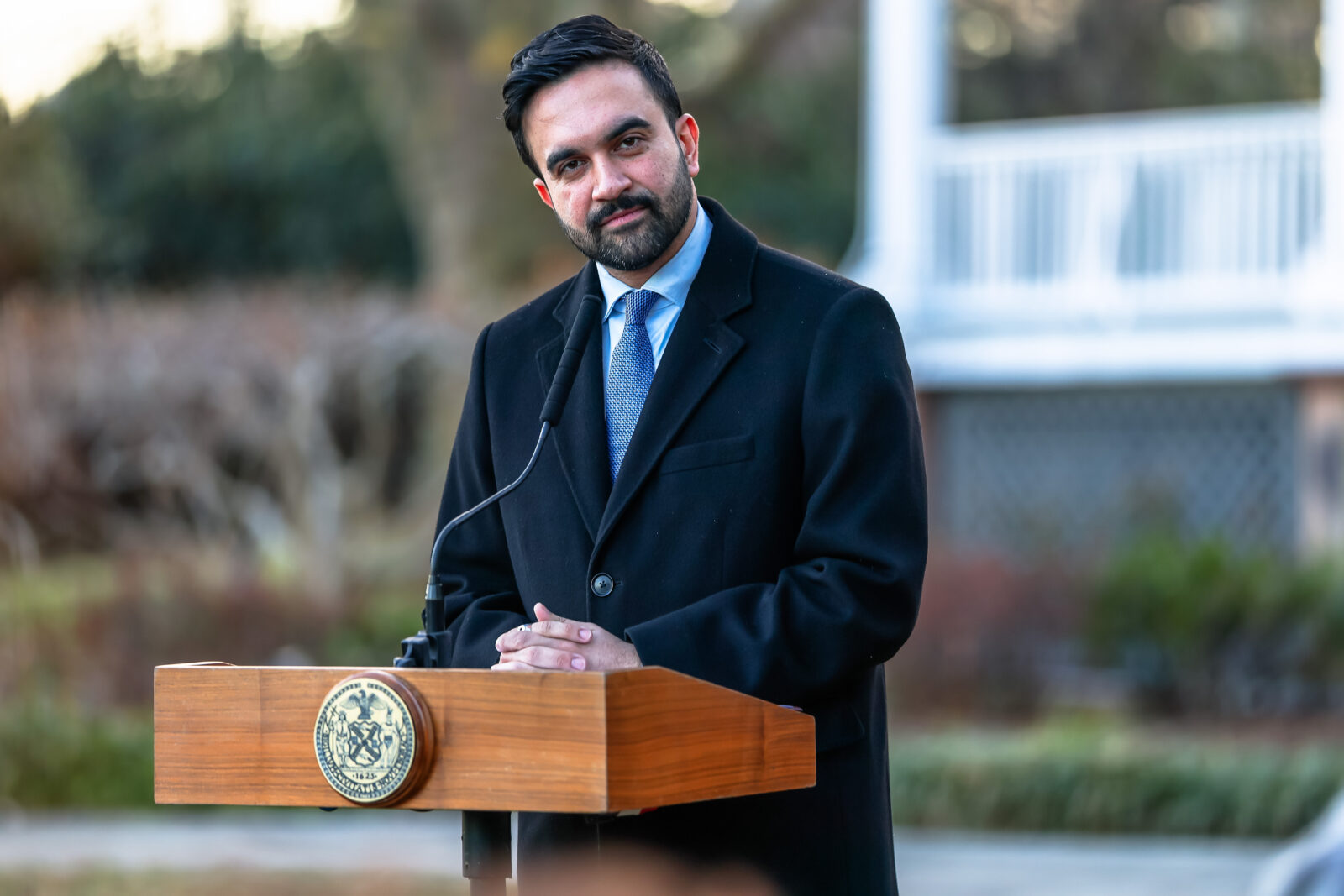
New York City Mayor Zohran Mamdani sparked an uproar among Jewish community leaders when, on his first day in office, he revoked an executive order that adopted a definition of antisemitism equating some criticism of Israel with anti-Jewish prejudice.
But the mayor has yet to articulate which, if any, definition of antisemitism he will abide by, raising questions about his views toward escalating anti-Jewish hate in the city as he continues to weigh in on high-profile issues affecting the Jewish community.
His recent comments responding to pro-Hamas protesters in Queens last week and an arson attack on a synagogue in Jackson, Miss., over the weekend illustrate what Mamdani’s critics interpret as a core tension animating his assessment of antisemitism.
While Mamdani released a statement on Sunday calling the arson a “violent act of antisemitism,” his comment on the demonstration outside a synagogue in Kew Gardens Hills where protesters openly voiced support for Hamas was delayed and came only after he faced growing pressure from media outlets and Jewish community leaders to denounce the demonstration.
In contrast with several of his top allies on the left, Mamdani, who has long been an outspoken critic of Israel, ultimately chose not to the call the protesters antisemitic, even as he otherwise denounced Hamas as a “terrorist organization” and said that the chants heard at the demonstration “are wrong and have no place in our city.”
The statements on two separate issues in different states helped distill how Mamdani has traditionally reacted to individual instances of antisemitism. He has unequivocally condemned as antisemitic recent incidents where Jews have faced violent attacks and have been targeted by vandalism, among other acts. But the mayor has been slower to react decisively on protests near Jewish institutions involving anti-Israel activism.
Mamdani, who has long identified as anti-Zionist and refuses to recognize Israel’s right to exist as a Jewish state, drew backlash last November after he admonished a Manhattan synagogue that was also targeted by anti-Israel demonstrators who chanted slogans including “death to the IDF” and “globalize the intifada,” a phrase he has declined to renounce.
Even as he distanced himself from the language used by protesters in objecting to an event about immigration to Israel, Mamdani said that “sacred spaces should not be used to promote activities in violation of international law,” a statement he later revised. He did not label the protest antisemitic, as other elected officials had done. On the recent Queens protest outside an Israeli real estate event, Mamdani used similar language when asked why he hadn’t condemned “both sides.” He answered, “I absolutely have an opposition to the sale of land in the West Bank. It’s a violation of international law and that comes from my belief in the importance of following international law.”
His ongoing reluctance to explicitly identify such protests as antisemitic underscores how his record of pro-Palestinian activism has long been central to his self-conception. While he moderated on several key issues in the election, Mamdani notably resisted softening even some of his most controversial views relating to Israel — such as a pledge to arrest Israeli Prime Minister Benjamin Netanyahu on charges of war crimes.
“On an ideological level, it’s a very problematic issue to be a proud anti-Zionist — especially if you are the mayor of New York City,” Rabbi Ammiel Hirsch, who leads Stephen Wise Free Synagogue on Manhattan’s Upper West Side, said. “On a practical level, wherever anti-Zionism has been normalized,” he said, “as night follows day, it leads to antisemitism, in every single case, and it is the case today. There won’t be an exception simply because the mayor, at this time, insists on being an anti-Zionist and is proud of it.”
Rabbi Ammiel Hirsch, who leads Stephen Wise Free Synagogue on Manhattan’s Upper West Side, said in an interview with Jewish Insider on Monday that he has spoken with Mamdani repeatedly about what he called a clear connection between anti-Zionism and antisemitism — which, he noted, the mayor has not acknowledged.
Even as Hirsch conceded “it’s not necessarily the case in every circumstance” that “anti-Zionism is, ipso facto, antisemitism,” he said such discussions are “completely divorced from reality,” disagreeing with Mamdani’s assessment of the Queens protest last week. “What Jews mean by anti-Zionism is not what Hamas means by anti-Zionism,” he explained. “If you are pro-Hamas, then you are, by definition, an antisemite.”
“On an ideological level, it’s a very problematic issue to be a proud anti-Zionist — especially if you are the mayor of New York City,” Hirsch argued to JI. “On a practical level, wherever anti-Zionism has been normalized,” he said, “as night follows day, it leads to antisemitism, in every single case, and it is the case today. There won’t be an exception simply because the mayor, at this time, insists on being an anti-Zionist and is proud of it.”
The working definition of antisemitism Mamdani rescinded, which is promoted by the International Holocaust Remembrance Alliance, has long been a target of anti-Israel activists and some progressives who believe it stifles legitimate criticism of Israel — even as it is widely accepted as useful guidance by mainstream Jewish groups.
A spokesperson for Mamdani did not respond to a request for comment from JI asking how he would define what he has frequently called “the scourge of antisemitism” while pledging to ensure the safety of Jewish New Yorkers.
Mamdani has yet to announce key administration hires for areas related to antisemitism, such as the office to combat antisemitism, which he has vowed to retain, and he has sent mixed messages regarding his efforts to fight antisemitism — voicing interest, for example, in a city curriculum embraced by leading Jewish groups that promotes a definition of Zionism seemingly at odds with his own views on Israel.
Shortly before his inauguration, Mamdani argued that a report issued by the Anti-Defamation League, which highlighted several members of his transition team who had used antisemitic tropes and justified Hamas’ Oct. 7, 2023, attacks, ignored what he called “the distinction between antisemitism and criticism of the Israeli government.” He did not address some of the most extreme comments made by appointees, but said the ADL report “draws attention away from the very real crisis of antisemitism we see.”
Mark Goldfeder, the director of the National Jewish Advocacy Center, said he suspects that Mamdani is now “gearing up to adopt” what he characterized as “one of the ‘IHRA-lite’ definitions” of antisemitism, citing those embraced by the Jerusalem Declaration on Antisemitism and the Nexus Project — which he called “a little better than JDA,” though neither are widely accepted by mainstream Jewish organizations. Both definitions, he argued to JI, “provide more cover to those who wish to hide their antisemitism behind the curtain of anti-Zionism.”
Jonathan Jacoby, the president and national director of the Nexus Project, said in a statement to JI on Monday that Mamdani “and all public officials should be judged by the actions they take to protect Jewish communities — not by their adherence to any one controversial definition of antisemitism.”
According to Goldfeder, applying the Nexus definition to the recent incidents addressed by Mamdani “would mean that attacking Jews at a synagogue,” as in Jackson, “would be antisemitic — but harassing them, as long as no physical attack” took place, as in Queens, “would be fine.”
“I, for one, am not OK with either,” Goldfeder said. “Neither are the federal government, the majority of U.S. states and the vast majority of Americans both Jewish and non-Jewish.”
Jonathan Jacoby, the president and national director of the Nexus Project, said in a statement to JI on Monday that Mamdani “and all public officials should be judged by the actions they take to protect Jewish communities — not by their adherence to any one controversial definition of antisemitism.”
“Mamdani has expressed a clear commitment to engaging a wide range of Jewish voices in the fight against antisemitism and hate, and affirmed that the city will continue to operate an office to combat antisemitism,” Jacoby added. “Instead of getting hung up on fights over definitions like IHRA that were never intended to be enshrined into law, we need to see more security funding for vulnerable institutions, more support for more education about antisemitism and bias, and the enforcement of civil rights laws to prevent actual discrimination and harassment.”
Amy Spitalnick, the CEO of the Jewish Council for Public Affairs, said that the “biggest question” for her “is not whether the mayor personally adopts a specific definition but, rather, how he will respond to acts of antisemitism and invest in a comprehensive strategy to counter it.”
Rabbi Marc Schneier, who has spoken privately with Mamdani about issues concerning the Jewish community, said he was “pleasantly surprised” that Mamdani spoke out against the Queens protest and called Hamas a terror group, noting that the mayor had faced scrutiny for not even mentioning Hamas in his initial statement regarding the Oct. 7 attacks.
“We may be witnessing some evolution in terms of his understanding of Israel,” Schneier told JI, while adding that the Jewish community has “a long way to go.”
Amy Spitalnick, the CEO of the Jewish Council for Public Affairs, said that the “biggest question” for her “is not whether the mayor personally adopts a specific definition but, rather, how he will respond to acts of antisemitism and invest in a comprehensive strategy to counter it.”
“I’ve appreciated his willingness to engage with our community and evolve his position and I hope that he will continue to do so,” she told JI on Monday. “The pro-Hamas protests in Kew Gardens and the arson attack in Jackson are different examples of the many ways antisemitism is manifesting right now. All of it threatens Jews and our broader society and democracy.”