Liri Agami
The 36 hours in Washington that took hostage families from grief to gratitude
The story of how the hostage families came to learn their loved ones were coming home, told to JI by key players


 Add JewishInsider on Google
When several dozen people gathered at the Kennedy Center for a yoga class overlooking the Potomac River on Oct. 8, the class began with a practice familiar to anyone who regularly does yoga: intention setting.
The class was called “Yoga for Carmel,” in honor of Carmel Gat, a 40-year-old Israeli yoga instructor who was taken captive by Hamas from Kibbutz Be’eri on Oct. 7 and killed last year alongside five other hostages, including Hersh Goldberg-Polin. Among those taking part in the class were former hostages and the family members of those still being held in Gaza, all of whom had gathered at the same spot a day earlier for a somber event marking two years since the attacks that reshaped their lives.
“What do you do in yoga? You set your intention. You think about the release of the hostages. That’s all we thought about during the entire yoga session,” recalled Matan Sivek, who until last month was the director of the Hostage Families Forum’s U.S. operation. As soon as the class ended, a cacophony of cellphones began ringing as news broke about a possible deal.
“At 6 p.m., we got the news that the deal might be happening, that it’s evolving super rapidly,” said Sivek. Soon it was confirmed: Israel and Hamas had agreed to a ceasefire that would result in the release of all the hostages and an end to the war. The news capped off an emotional 36 hours, which began with the Oct. 7 memorial event at the Kennedy Center a day earlier.
Sivek sat down with Jewish Insider last week for a wide-ranging conversation reflecting on the two-year-long advocacy campaign — spearheaded by Sivek, his wife Bar Ben-Yaakov and leading Jewish organizations including the American Jewish Committee and Schusterman Family Philanthropies — demanding the release of the more than 250 people taken hostage by Hamas during the Oct. 7, 2023, attacks.
“I’m very happy that I am part of something that was successful at the end. There are many initiatives and nonprofits around the world who try to solve different issues, and they will never solve them. People try to end famine. They try to find a medicine for cancer. They try to stop addiction,” said Sivek. “For us, it’s something that you can say, ‘Wow, we really saved lives.’”
Advocating for the hostages was a task that Sivek and Ben-Yaakov took on almost by accident, but they ultimately became the address for Israeli hostage families who came to Washington to advocate for the release of their loved ones. The couple helped arrange meetings with Democratic and Republican lawmakers, officials in the Biden and Trump administrations and political and faith leaders around the country. Their strategy was to meet with anyone who would listen.
“We really were here to say that this humanitarian issue transcends all politics, and this was our strategy from Day One,” said Sivek.
It made sense, then, that the moment when President Donald Trump shared with the families that the hostages would be coming the following Monday — five days after that yoga class — was in a phone call to the hostage families as they stood in Sivek and Ben-Yaakov’s Georgetown living room. A video of the call, placed by Commerce Secretary Howard Lutnick, who put Trump on speakerphone, quickly went viral and appeared on news broadcasts around the world.
“President Trump, you have the best crowd in the world,” Lutnick said into the phone.
Everyone in the room shouted together, smiles on their faces: “Thank you!”
“You just take care of yourselves. The hostages will come back. They’re all coming back on Monday,” Trump said. Among those in the room were released hostages Keith Siegel, Iair Horn, Doron Steinbecher and Arbel Yehoud, as well as family members of Gali and Ziv Berman and Omri Miran, who at the time were still in Gaza, along with Horn’s brother Eitan and Yehoud’s partner Ariel Cunio.
“This is the moment when the world realized the timing of the release of the hostages,” said Sivek.
The White House deputy press secretary, Anna Kelly, told JI this week that Trump was deeply affected by the story of the hostages.
“President Trump is always motivated to end human suffering around the world, and he was horrified by the images of Oct. 7 and the capture of innocent Americans, Israelis and others taken hostage by Hamas,” said Kelly.
Within the Trump administration, Lutnick was working behind the scenes on behalf of the hostages. His wife, Allison, was the driving force behind his advocacy.
Allison Lutnick had gotten to know many of the families after a trip to Israel early last year, when she met the mother of Omer Shem Tov, a hostage who was freed in February. Allison then connected with Sivek when she moved to Washington this year, and soon after he facilitated a meeting between the Lutnicks and several freed hostages at the Lutnicks’ apartment in Miami.
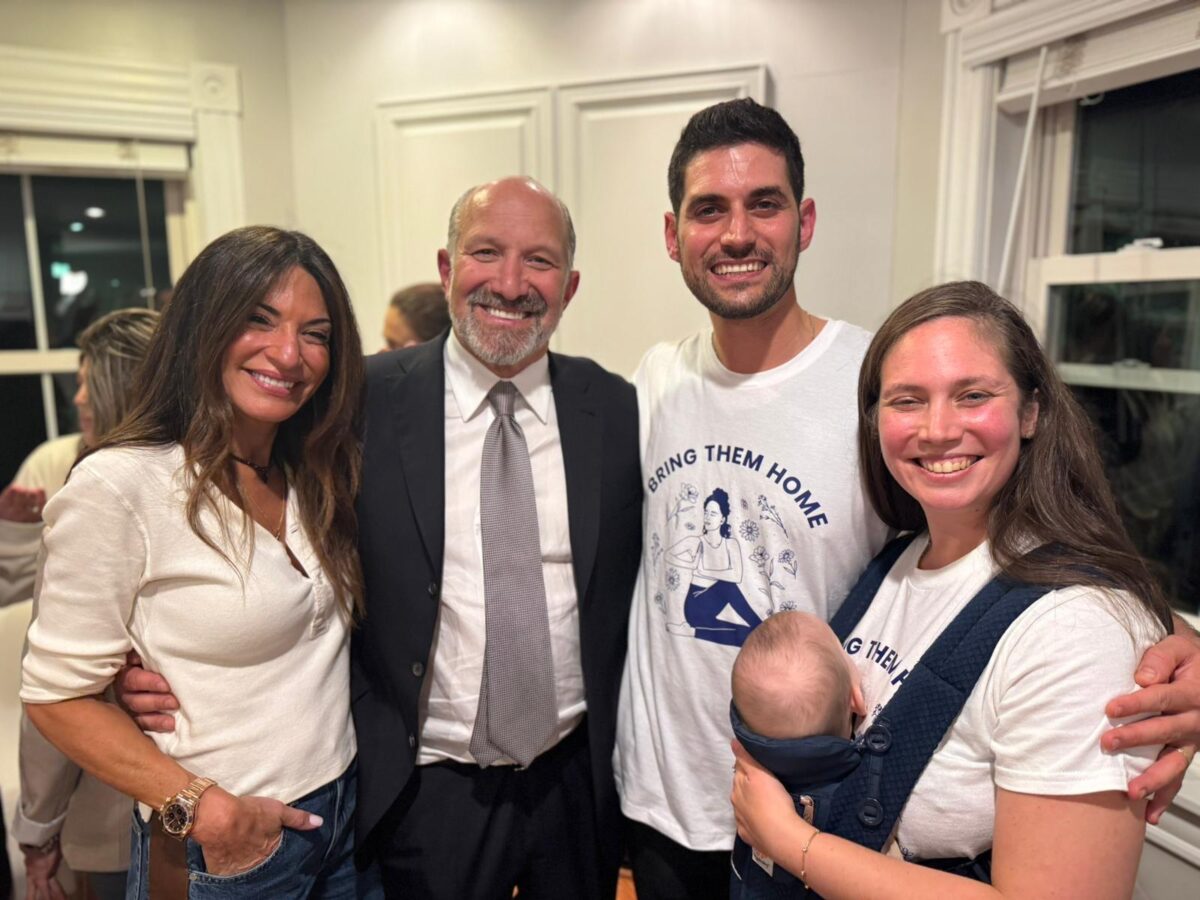
“We spent three three hours together in our apartment talking and sharing. They spoke of the horrors of what they’d been through and we spoke of the horrors of what we had been through 24 years earlier on 9/11,” she told JI on Wednesday. At the time, Howard Lutnick was the CEO of the financial firm Cantor Fitzgerald, which lost 658 employees on 9/11, including his brother Gary.
“There was definitely a bond between all of us, having experienced a terrorist attack and the loss of loved ones and horrible trauma,” she added. “Howard and I felt this very deep connection with them and what they were going through. We had an understanding of it.”
Whenever Sivek asked, Allison Lutnick texted leading administration officials like Vice President JD Vance, Attorney General Pam Bondi and Defense Secretary Pete Hegseth directly to set up meetings for them with hostage families. The Lutnicks’ family foundation supported the Sukkah of Hope at the Kennedy Center, where the Oct. 7 commemoration event took place. (The sukkah was supposed to be set up on the Ellipse, outside the White House, but the government shutdown scuttled that plan. So Allison Lutnick, a Kennedy Center board member, reached out to the center’s president, Ric Grenell — and, thus, it was moved there.)
She and her husband both spoke at the memorial event, and that morning in the sukkah, a majority of Trump administration cabinet secretaries gathered for a breakfast with the hostage families.
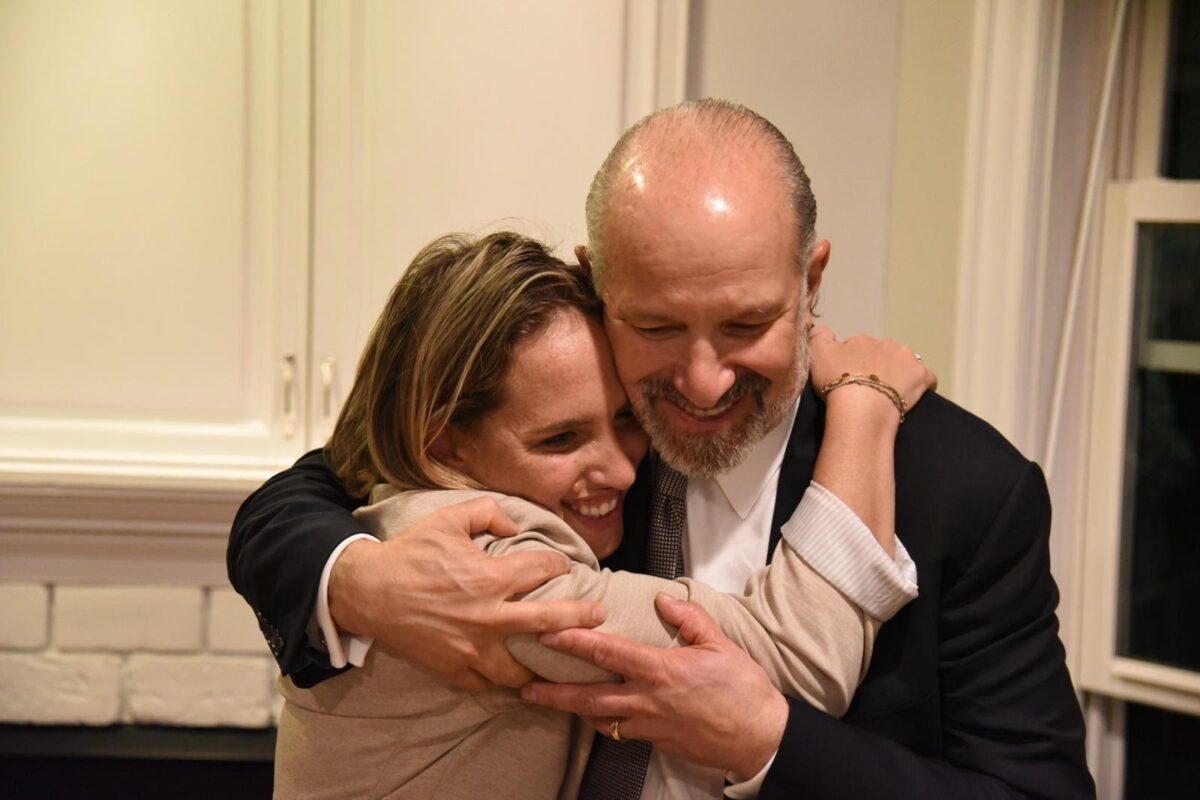
“We are part of you. We are with you, and we will help get them home,” Howard Lutnick said in a speech. Less than 36 hours later, there was a breakthrough in the deal.
“The two-year anniversary of Oct. 7 was a day of intense emotion, sadness, mourning and disbelief and horror that it’s been two years. And then the next day, Oct. 8, was this incredible elation. It just couldn’t have been more different,” Allison Lutnick said. “It was extraordinary to walk into Matan’s house later that night and celebrate with the families. It was the first time I’d ever seen them smile for a picture.”
She and her husband arrived at the impromptu celebration with two bottles of champagne. Meanwhile, Lisa Eisen and Stacy Schusterman, the president and the chair of Charles and Lynn Schusterman Family Philanthropies, showed up with food for 30. They had been planning to host Sivek’s family and all the hostage families for Sukkot that night — Eisen and her husband had purchased a larger sukkah in preparation — but the gathering never happened.
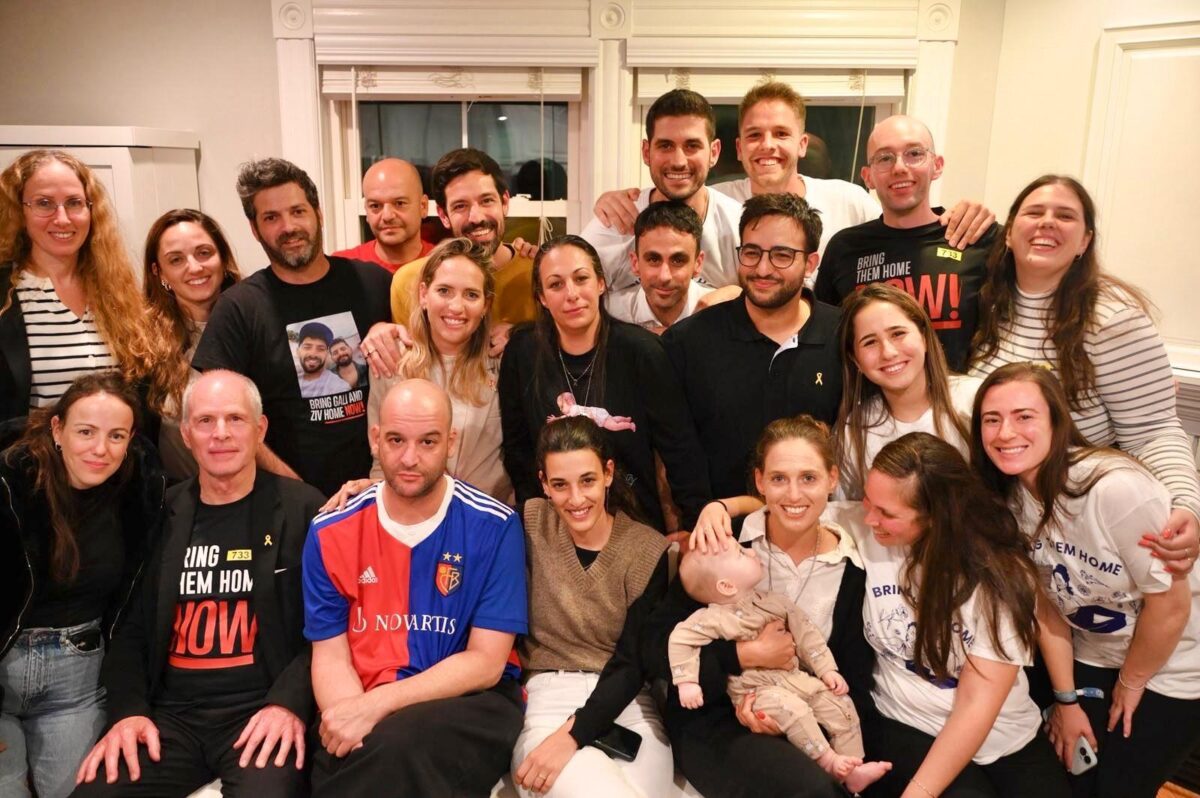
“I called Lisa. I was like, ‘Lisa, you worked so hard for this dinner, but I think we cannot make it.’ And it was 6 p.m. At 7 we were supposed to be there,” Sivek said. “I was like, ‘A deal is happening. I cannot take them from the city. They need to stay here.’”
“I said, ‘Well, this is the best excuse ever to not come,’” Eisen recounted to JI. She and her family sat down to eat, toasted the hostages and said the Shehechiyanu prayer, expecting to have a much smaller dinner at home. Then Sivek asked her to come celebrate with them.
“So we packed up all of the food for 30 people, and we drove down to Matan and Bar’s house, and we set up the meal because they had no food,” said Eisen, who split the cooking with her husband: three kinds of soup (coconut lentil, red lentil and matzoh ball), schnitzel, salads, homemade hummus, pies and cakes. “It was one of the most powerful, moving, beautiful moments. And I have to say, Matan and Bar, it wouldn’t happen without them. They were so tireless.”
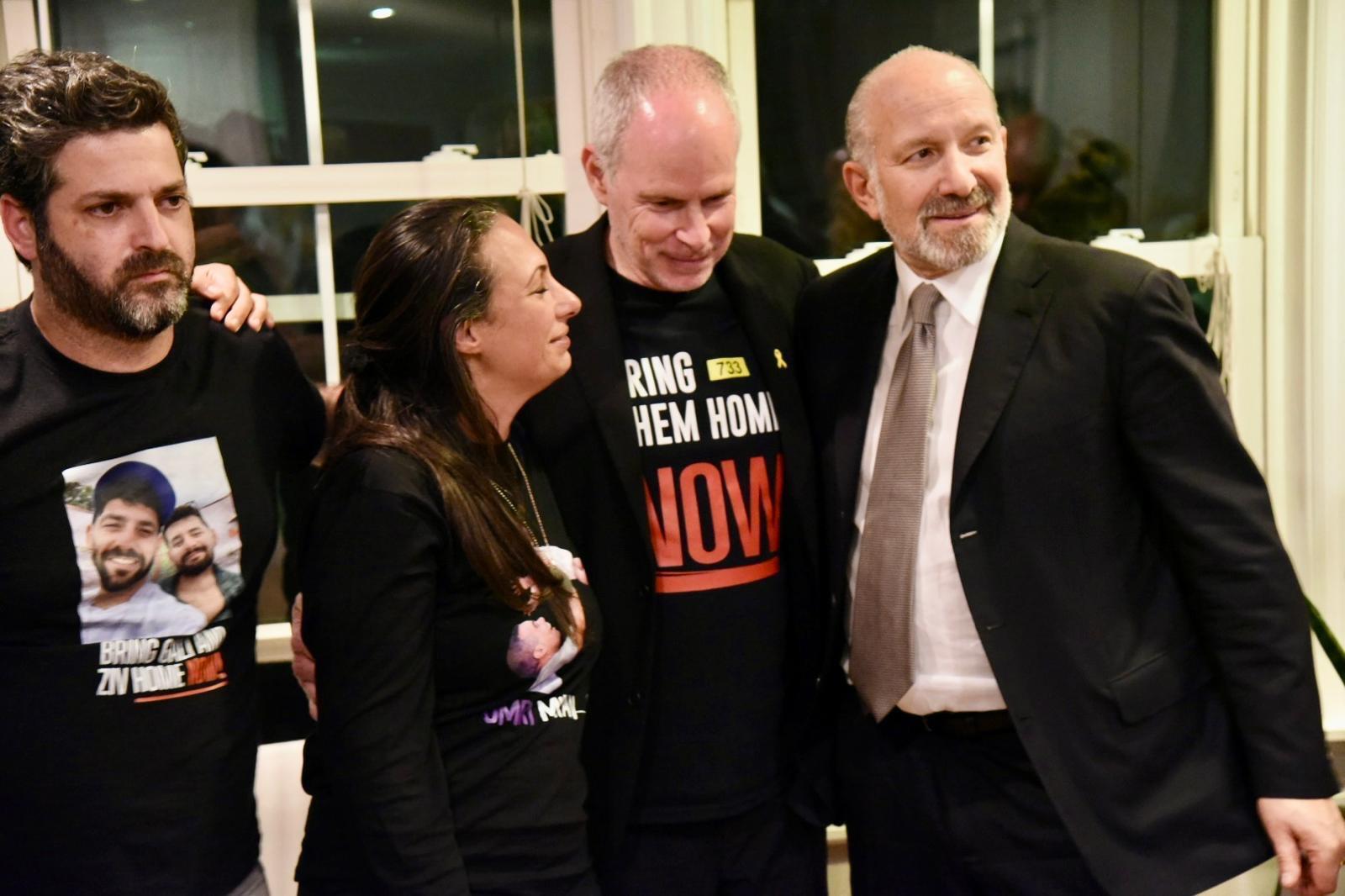
It was in that environment with hugging and crying and eating — critical to any Jewish event — that everyone realized this deal, finally, seemed to be real.
“This is how our kitchen became famous,” Sivek said with a laugh. “For us it was some sort of closure as well, the fact that after two very difficult years, the announcement came from our kitchen.”
Almost immediately, Sivek and his partners began booking the Israelis on flights back home; less than a week later, they would be reunited with their loved ones. It was a moment these Israelis had hardly dared to imagine during the agony of the preceding two years. In that period, their pain was shared by Jews around the world, who wore dog tags and yellow ribbon pins to constantly remind others of the people imprisoned in Gaza.
“Many people view this as a miracle that happened, that they’re out, and of course, it seemed like a miracle. But there was a lot of work of hostage families and former hostages behind the scenes to make it happen,” Sivek said. “I think that the Jewish people should be very, very proud of themselves, that we stood by our people, and we actually managed to save their lives.”