Win McNamee/Getty Images
Trump prioritizes Saudi partnership, leaving Abraham Accords on hold
Despite announcing sweeping security, investment and defense agreements, the fate of a Saudi-Israel normalization deal remains uncertain


 Add JewishInsider on Google
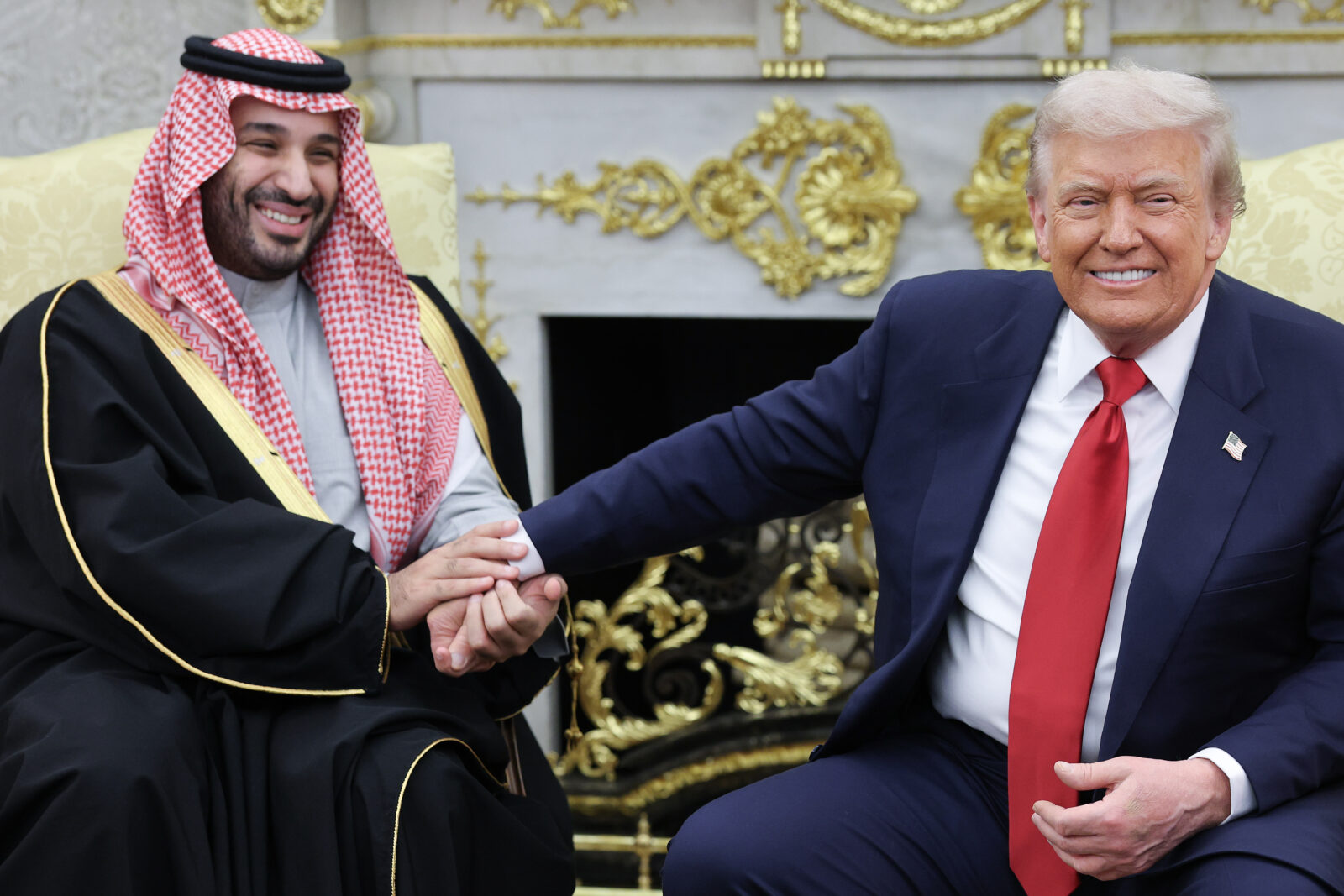
During Tuesday’s meeting between President Donald Trump and Saudi Crown Prince Mohammed bin Salman, the leaders strengthened their relationship and confirmed the completion of several deals. Any plan to utilize such transactions as part of normalization with Israel, however, was notably absent.
While taking questions from reporters in the Oval Office, Trump confirmed that the U.S. would sell Saudi Arabia F-35 fighter jets of similar caliber to Israel’s. At a dinner that evening, the president added that a strategic security agreement had crossed the finish line, while also formally naming Saudi Arabia a major non-NATO ally. On Wednesday, the two countries announced a strategic artificial intelligence partnership.
“The main takeaway of the visit was the normalization of the U.S.-Saudi relationship,” said Aaron David Miller, a senior fellow at the Carnegie Endowment for International Peace and former State Department negotiator. “[There was] very little, it seemed to me, not surprisingly, on the side of normalization to Israel. It’s almost as if Israel was sort of an afterthought this visit.”
When asked by reporters why normalization with Israel was not prioritized, Trump did not provide much of a response, instead asserting that Israel is “going to be happy.”
Observers had anticipated that Trump would roll out the red carpet for MBS on his visit to Washington. What remained unknown was whether the deepening ties between Washington and Riyadh would come with progress between Saudi Arabia and Israel, the United States’ closest ally in the region.
But the deals announced this week were made without any apparent requirement of progress toward normalization, leading some experts and leaders of pro-Israel groups to raise questions about the Trump administration’s strategy.
“By the way this was done, President Trump seems to have elevated the partnerships with Saudi Arabia and maybe, to some degree, with other Gulf states, above pretty much all other U.S. partnerships, including Israel,” said Dan Shapiro, a former U.S. ambassador to Israel under former President Barack Obama.
“So that means that other considerations, like ensuring the right incentives are still in place for Saudi Arabia to normalize relations with Israel or ensuring that military sales are done in a way that protects U.S. interests and Israel’s security interests, may be less important than they have been under previous administrations.”
Shapiro said that while it is reasonable for the U.S. to strengthen its partnerships with Gulf countries, the deals gave away major incentives for normalization “without knowing whether it can be achieved later.” He also added that it came without guarantees from the Saudi government on limiting military cooperation with China and Russia.
Anne Dreazen, the vice president for the American Jewish Committee’s Center for a New Middle East, told JI that Saudi-Israeli normalization could not have been achieved on this visit, adding that it was “not in the cards right now.”
“Now the paradigm is shifting where it’s about peace between Israel and Saudi Arabia being logical and good based on its own merits, when they can get the politics right and when they can reach agreement on the Palestinian issue,” said Anne Dreazen, the vice president for the American Jewish Committee’s Center for a New Middle East.
“Right now we’re not there. The politics in Israel and Saudi Arabia are not right for this,” said Dreazen. “I think President Trump realized that it wasn’t going to happen in this visit and wanted to move ahead with these deals because there’s a strong perception that making some deals with Saudi Arabia is in America’s interest.”
Dreazen, however, still believes normalization is “going to happen,” adding that she has confidence from conversations with Saudi officials that political differences will be resolved in the future.
Trump’s decision to make significant deals with Saudi Arabia while not pressing for normalization suggests the White House is taking a different approach than in the past, Dreazen argued.
“Now the paradigm is shifting where it’s about peace between Israel and Saudi Arabia being logical and good based on its own merits, when they can get the politics right and when they can reach agreement on the Palestinian issue,” said Dreazen, a shift from how former President Joe Biden approached negotiations.
But with MBS leaving Washington with so many deliverables, it’s unclear whether he will still prioritize normalization.
The Israelis are “going to be right to worry that the Saudis may feel like they’ve gotten everything they want and don’t have any need left for normalization,” Shapiro said.
Following his Oval Office meeting with Trump, the Saudi crown prince told reporters, “We want to be part of the Abraham Accords, but we want also to be sure that [we] secure a clear path [toward a] two-state solution.”
Leaders of pro-Israel groups said normalization between Israel and Saudi Arabia should remain a top policy priority for the U.S.
“The United States would be stronger and more secure if our major non-NATO allies worked together to promote regional peace, stability and prosperity,” said AIPAC spokesman Marshall Wittmann. “This objective would be advanced if Saudi Arabia joined the Abraham Accords, and U.S. leaders should urge it to do so.”
In a statement released on Wednesday, Democratic Majority for Israel’s president and CEO, Brian Romick, said that expanding the Abraham Accords must be “central to U.S. policy,” and urged Congress to play an active role in reviewing U.S. defense agreements with Saudi Arabia.
“Any substantial upgrade in the U.S.–Saudi relationship — including access to advanced U.S. defense systems — must be tied to meaningful, measurable progress toward Saudi-Israeli normalization,” Romick said in a statement. “It is now incumbent on the Trump Administration to use our leverage with Saudi Arabia to make real progress toward normalization.”
“There’s clearly a political dynamic going on here,” said Israel Policy Forum chief policy officer Michael Koplow. “Trump went out of his way to almost poke at the Israelis. He implied that [the U.S. is] OK with the Saudis getting F-35s but [the Israelis] want the Saudis to get a less advanced version, and he almost seemed to boast about the fact that he’s going to give the Saudis whatever he wants no matter what Israel says.”
Trump’s promise of F-35 sales to Saudi Arabia has raised questions about which model and allowances Riyadh will receive and whether Israel will maintain its qualitative military edge, which the U.S. is bound by law to uphold. To date, Israel is the only country in the Middle East to have obtained the fighter jet.
U.S. officials and experts told Reuters that the F-35 jets the U.S. plans to sell to Saudi Arabia will lack superior features that Israel’s fleet has.
Israel Policy Forum chief policy officer Michael Koplow voiced concerns about the security aspect of the deals.
“It doesn’t surprise me that all of these things are going ahead,” said Koplow. “What surprises me more is that some of the things that have been discussed over the past couple of days seem to put Israel in a more difficult security position, particularly this question of sales of F-35s.”
Israel’s government, meanwhile, has stayed largely quiet about the F-35 sales, though the Israeli Air Force has objected to the deal, warning that it could damage Israel’s air superiority in the region
“There’s clearly a political dynamic going on here,” said Koplow. “Trump went out of his way to almost poke at the Israelis. He implied that [the U.S. is] OK with the Saudis getting F-35s but [the Israelis] want the Saudis to get a less advanced version, and he almost seemed to boast about the fact that he’s going to give the Saudis whatever he wants no matter what Israel says.”