Haim Zach/GPO
Experts raise red flags over AI’s potential to disrupt Israel’s next election
Experts are raising red flags on the technology’s ability to influence voters and the lack of regulations around its use


 Add JewishInsider on Google
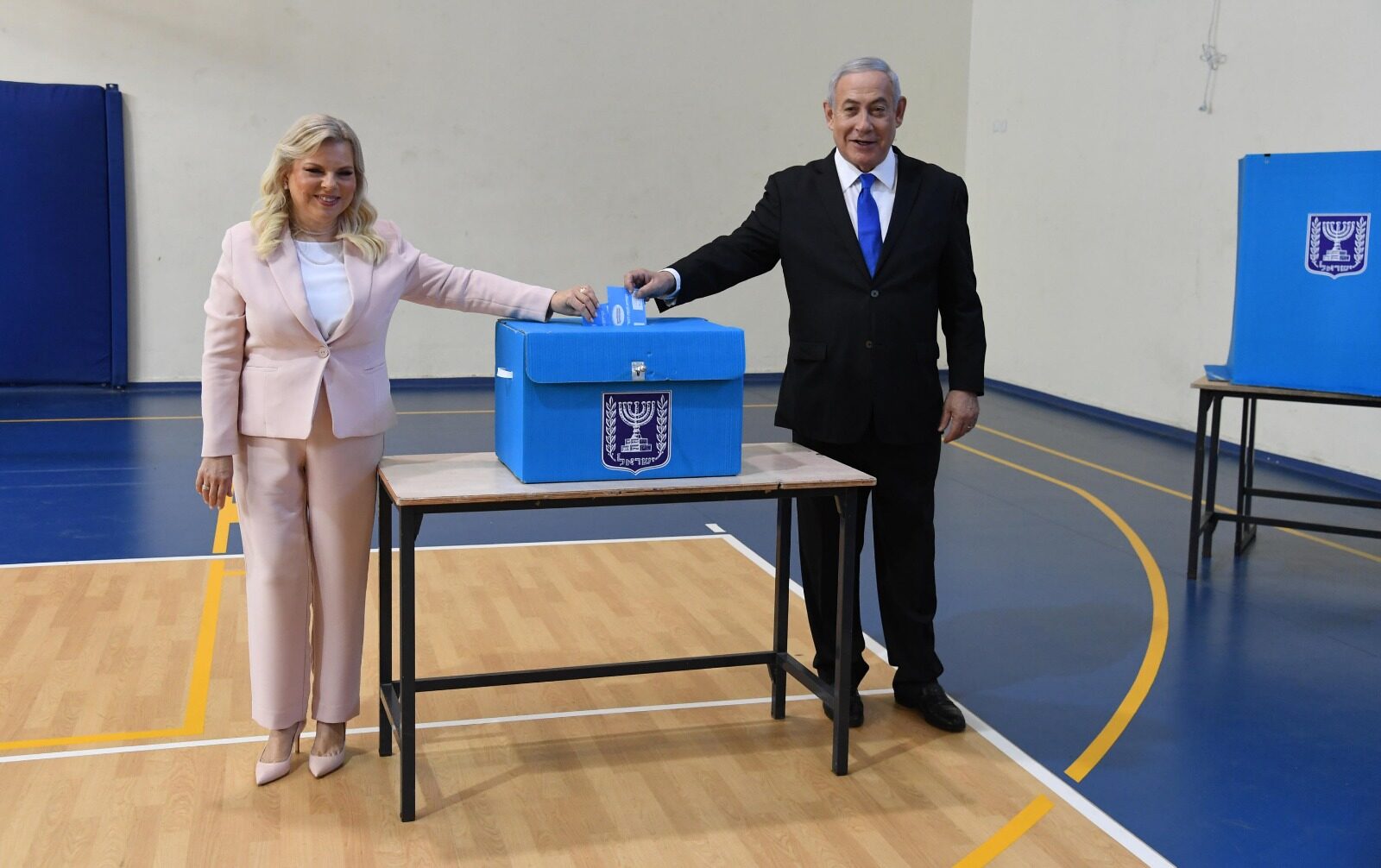
The run-up to next year’s Israeli election will be the first in which artificial intelligence tools to create images and videos and rapidly compose texts are easily accessible, and experts are raising red flags over the technology’s ability to influence voters and campaigns and the lack of regulations around its use.
Israeli politicians have long been early adopters of technological tools to boost their campaigns, from bypassing traditional media through Facebook to using social media data to target key demographics before most liberal democracies were doing so, and AI will likely be no different.
Tehilla Shwartz Altshuler, head of the Democracy in the Digital Age program at the Israel Democracy Institute, told Jewish Insider that Israel is one of the countries with the largest market penetration of AI in the world — 85% of Israelis have used ChatGPT and 76% use it frequently, according to a study by the Israeli Internet Association published in October — so it is only a matter of time before politicians use it in their campaigns.
(National elections are legally required to take place on Oct. 26, 2026, at the latest, but political tensions make an earlier date possible.)
“AI chatbots have significant penetration in the public,” Shwartz Altshuler said. “They will be used to ask whether to vote and for whom to vote. We have not seen anything like this before. … People use chatbots as a companion for emotional support. The concern over the great influence of chatbots on voter behavior is significant.”
Shwartz Altshuler said that there have already been attempts to “give poison injections” to AI models, such as creating fake news sites and positions on subreddits to manipulate the bots into giving more pro-Israel responses to users abroad, and those tools can be turned inward, toward Israeli voters.
She also pointed out that Israel does not have any laws requiring machine-generated content to be labeled.
“This is the first time we have an election in which we are unable to differentiate between authentic and machine-generated photos and videos,” she said. “There is a fear that the perception of reality is being undermined. People can forge documents and make deepfakes of politicians. … Machine-generated content can create an alternative reality, a very dangerous prospect when the content is very emotionally attractive.”
Yuval Dror, the former dean of media studies in Israel’s College of Management Studies, who hosts a popular technology podcast in Hebrew, was skeptical that computer-generated photos and videos will have a major impact on the next election.
“With photos, sometimes we can tell if it’s AI or not. With video, people usually know that it’s AI,” he told JI. “The impact of [AI-generated] video will mostly be economic, because it will be much easier to produce. In the past, you needed an ad agency, actors, post-production work. Now it’s much easier, so [campaigns will] save money.”
“You can create a false presentation in which masses of people say this or that and look like a grassroots movement,” Yuval Dror, the former dean of media studies in Israel’s College of Management Studies, said. “There is [already] an army of bots echoing a few people on social media.”
Dror was more concerned about AI-generated texts, which he noted can be much harder to detect.
AI may be used in upcoming political campaigns to flood social networks with content, making a candidate, message or policy appear to have more support than it does in reality. This already happens on X, where much of the political discourse in Israel takes place, but also in more closed networks like WhatsApp and Telegram, Dror said.
“You can create a false presentation in which masses of people say this or that and look like a grassroots movement,” Dror said. “There is [already] an army of bots echoing a few people on social media.”
“We’ve seen this for years. It will just get more and more convincing,” he added.
Shwartz Altshuler said that social media companies have difficulty stemming mass-bot content. “Generative AI can create a lot of versions of the same content, so the result is inauthentic, coordinated behavior on social media,” she said. “If there are slightly different versions of the same content, the social networks don’t detect” that it comes from bots.
“Most of these [AI tools] are not mentioned in the law or by past Central Election Committee decisions. They are in a grey area. [Campaigns] will do what they want,” Tehilla Shwartz Altshuler, head of the Democracy in the Digital Age program at the Israel Democracy Institute, predicted.
In addition, developments in AI since the last Israeli election, in 2022, can help politicians use data even more effectively to target potential voters with different kinds of messages and ads, she said.
Shwartz Altshuler recounted speaking with a prominent Israeli political strategist who told her, “First we win elections, and then we see if what we did is legal or not.”
“Most of these [AI tools] are not mentioned in the law or by past Central Election Committee decisions. They are in a grey area. [Campaigns] will do what they want,” she predicted.
Despite the fertile ground for election fraud using AI, Shwartz Altshuler said it is unlikely that new laws will be passed before the next election. “This coalition has no motivation to pass such laws [and] usually the courts say laws [regarding elections] can only be applied after the next election.”
She also pointed out that the current Central Election Committee chairman, Noam Solberg, is a conservative Supreme Court justice, and therefore would be unlikely to instruct the Knesset to pass laws addressing the issue.
Despite all the advances in AI, it may not be enough to cover for a weak candidate.
Dror said that Israeli politicians are already using AI to write texts for social media or speeches: “Some politicians are not capable of stringing together two sentences, so they let AI do it, but the result is no less awkward.”
They have also generated all kinds of pictures to post online, which Dror said “makes [them] look stupid,” using Israeli Environmental Protection Minister Idit Silman, who posted a picture earlier this year depicting French President Emmanuel Macron kissing Hamas leader Yahya Sinwar, as an example. Israeli Defense Minister Israel Katz frequently posted AI-generated images ridiculing Israel’s enemies when he was foreign minister last year.
“I don’t know that there’s an audience for this stupidity,” Dror said.