






























2026 State Dept. funding bill leverages U.S. funding to combat antisemitism, anti-Israel bias in U.N.
The bill withholds 10% of the U.S. contribution for the U.N. or any U.N. agency until the State Department confirms to Congress that the agency is ‘taking credible steps to combat anti-Israel bias’
ANGELA WEISS/AFP via Getty Images
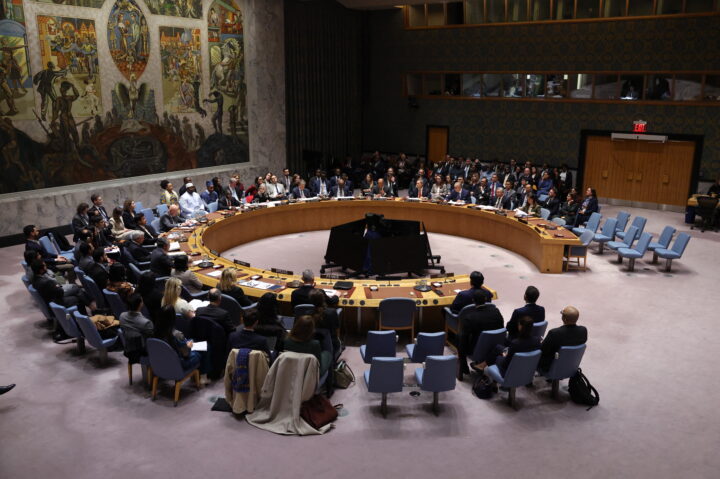
Ambassadors and representatives to the United Nations meet at the U.N. Security Council to vote on a U.S. resolution on the Gaza peace plan at the U.N. Headquarters in New York City, Nov. 17, 2025.


 Add JewishInsider on Google
The finalized 2026 funding package for the State Department, released Sunday, leverages a portion of the U.S.’ contributions to the United Nations and its agencies to push for changes in what the U.S. has said is the institution’s anti-Israel bias and antisemitism.
The bill withholds 10% of the U.S. contribution for the U.N. or any U.N. agency until the State Department confirms to Congress that the agency is “taking credible steps to combat anti-Israel bias,” putting measures in place to inform donors of when funds have been diverted or destroyed, “effectively vet[ting]” staff for ties to terrorism and taking steps to address antisemitism, among a variety of other anticorruption and accountability measures.
The moves put new financial teeth behind longstanding U.S. efforts to combat antisemitism at the U.N., as well as to ensure stronger oversight following revelations that members of the United Nations Relief and Works Agency participated in the Oct. 7, 2023, Hamas attacks on Israel.
However, the provisions relating to the U.N. in the final bill are significantly scaled back from the House’s draft of the legislation — which would have cut all U.S. funding for the U.N. regular budget and withheld funding for the U.N. secretariat pending a series of specific accountability steps relating to UNRWA personnel.
The explanatory report accompanying the bill includes a new requirement for relevant investigators general to provide a plan to Congress to conduct “risk-based investigations and related oversight of United States-funded implementing partners” of any aid provided in Gaza and the West Bank. It directs the administration to focus on reports of staff or contractors for such aid providers who have ties to or involvement in terrorism, and provide recommendations for addressing and preventing these issues.
The legislation maintains longstanding mechanisms governing U.S. aid to Gaza and the West Bank and the Palestinian Authority and new accountability measures implemented following the Oct. 7 attacks, as well as a ban on U.S. funding for UNRWA and a ban on funding for the U.N. Human Rights Council and its Commission of Inquiry investigating Israel.
It provisions limiting U.S. assistance to U.N. bodies if the Palestinians receive status equivalent to that of a state in any U.N. body.
The legislation provides the expected $3.3 billion in funding for military aid to Israel, as per the terms of the U.S.-Israel memorandum of understanding. It includes a new $5 million allocation for historical, archeological and cultural initiatives to strengthen the U.S.-Israel relationship. It also bans relocating the U.S. Embassy in Israel from Jerusalem.
The bill includes cuts to a number of U.S. assistance programs in the Middle East, including cutting funding for the Middle East Partnership for Peace Act program from $50 million to $37.5 million, for Israeli-Arab scientific partnerships from $8.5 million to $7 million and the Middle East Partnership Initiative from $27.2 million to $20 million.
It holds funding for joint U.S.-Israeli development projects in third countries at $3 million.
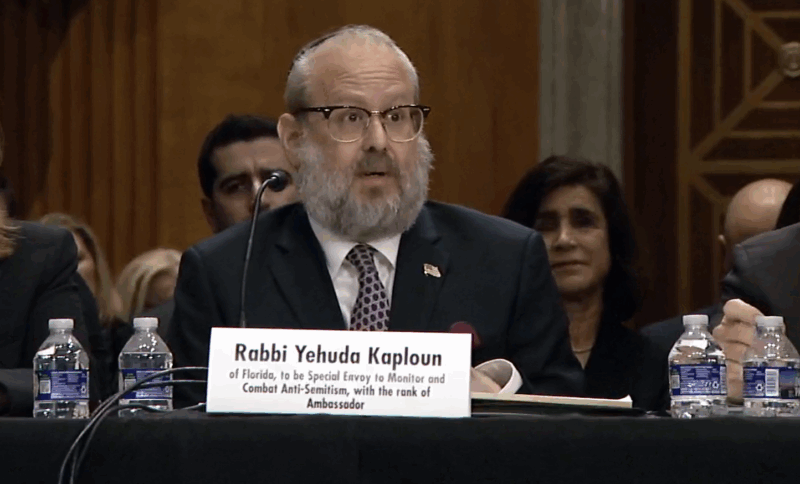
The legislation provides a significant boost in funding for the office of the State Department’s special envoy to monitor and combat antisemitism — $2.6 million, up from $1.75 million.
It also instructs the antisemitism envoy and the special envoy for Holocaust issues to work with the U.S. Holocaust Memorial Museum to prioritize efforts with U.S. partners to address Holocaust denial and distortion and antisemitism on social media and in artificial intelligence, and to brief Congress on a plan to tackle these issues. It directs the antisemitism envoy to consult with Congress on programs to combat antisemitism more broadly as well.
“At a moment when antisemitism is surging worldwide, the $2.6 million included in this minibus for the State Department’s special envoy to monitor and combat antisemitism is both necessary and timely,” Lauren Wolman, the Anti-Defamation League’s senior director of government relations and strategy, told Jewish Insider. “Antisemitic hatred is spreading across borders and being supercharged online, with real-world consequences for Jewish communities everywhere. This bill will strengthen U.S. leadership in confronting global antisemitism and sends a clear signal that combating antisemitism and Holocaust distortion is an urgent national priority.”
The legislation requires the administration to report to Congress on the impact of U.S. sanctions on Iran, as well as on U.S. efforts to eliminate Iranian oil exports to China — including the specific dates of communications between U.S. and Chinese officials about those imports.
The bill continues to bar the administration from revoking the Islamic Revolutionary Guard Corps’ terrorism designation, or entering into a nuclear deal with Iran in contravention of the Iran Nuclear Agreement Review Act. And it permits the use of funding to prevent Iran from obtaining a nuclear weapon, support democracy in Iran and otherwise combat Iranian malign activities.
It mandates that the State Department lay out a strategy, within 90 days, to expand the Abraham Accords, specifically including the possibility of providing arms transfers and other defense materiel to signatories.
The legislation includes $1.65 billion in funding for Jordan — $845 million in budget support funding for the government and $425 million in military aid.
The bill provides $1.425 billion in funding for Egypt, $1.3 billion of that in military aid, with $320 million conditioned on various human rights benchmarks, though those conditions can — and traditionally have been — waived.
For Lebanon, the bill provides $112.5 million, maintaining existing provisions and accountability measures emphasizing reforming the Lebanese Armed Forces and combatting Hezbollah.
The bill permits the provision of funding for nonlethal assistance in Syria, but bars the use of any funding to support Iranian, terrorist or Russian objectives and requires the administration to consult with Congress prior to providing any such funding.
It also requires the administration to report to Congress on the treatment of minorities in Syria and on whether the new Syrian government is taking “all sufficient actions” to protect them.
The bill allocates $20 million for the office of the special envoy for the Middle East, $2 million of that dedicated to activities in Lebanon, and $7 million for the office of the special envoy for Syria.
Several other provisions related to the Middle East that were included in the original House draft of the bill, including restrictions related to the International Court of Justice and International Criminal Court, preventing the establishment of additional diplomatic facilities in Jerusalem other than the U.S. Embassy and a directive to treat the West Bank and Gaza as separate entities for budgeting purposes have not been included in the final version of the bill.
From the House’s explanatory report, the negotiated version of the bill adopts anti-Boycott, Divestment and Sanctions provisions, as well as expanded vetting procedures to ensure political neutrality by aid recipients; new oversight requirements for U.S. aid to Syria; a report on antisemitism by foreign governments; a requirement for the State Department to report to Congress on efforts to end the PA’s terror payments program; and a report to the Congress on the possibility of a memorandum of understanding with Egypt on Security Assistance.
The legislation removes provisions included in 2024 appropriations legislation that prohibited military education and training funding for Saudi Arabia and that barred funding to support a Saudi nuclear program unless Saudi Arabia agreed to strict controls including renouncing uranium enrichment and reprocessing.
More Stories
eye on the prize
Virginia lawmaker with history of anti-Israel rhetoric eyes 2026 congressional run
center stage
Quincy Institute among anti-Israel sponsors of Doha Forum

doha forum dispatch
Hillary Clinton reiterates concerns about anti-Israel ‘propaganda’ targeting American youth

Fashion Faux Pas?
Anna Wintour mingles with Qatari royal who glorified Hamas’ slain leader

Fuentes’ following
New report documents foreign engagement driving online antisemitic activity