





























































Antisemitism envoy nominee Yehuda Kaploun likely to receive Senate vote before end of year
Kaploun’s nomination was advanced out of committee on Wednesday, with bipartisan backing

Joe Raedle/Getty Images
President Donald Trump and Rabbi Yehuda Kaploun light a candle during an Oct. 7th remembrance event at the Trump National Doral Golf Club on Oct. 7, 2024 in Doral, Florida.


 Add JewishInsider on Google
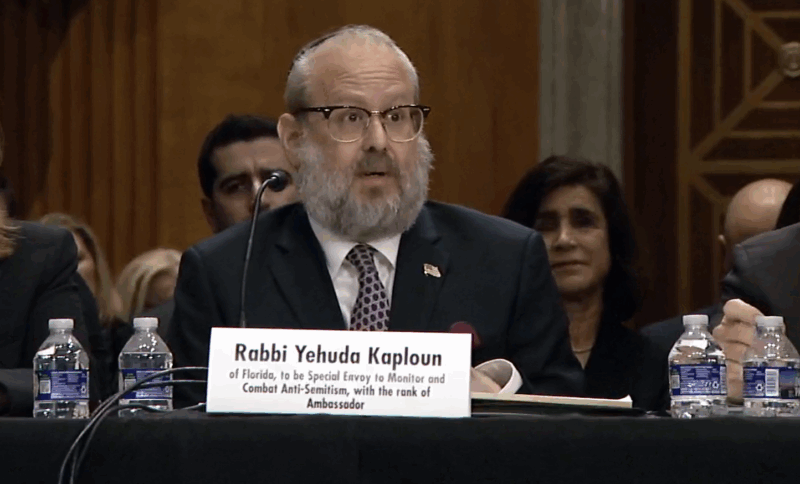
Rabbi Yehuda Kaploun, the Trump administration’s nominee to be the State Department’s special envoy to monitor and combat antisemitism, is expected to come before the full Senate for a confirmation vote before the end of the year, two sources familiar with the situation confirmed.
Kaploun’s nomination was advanced out of the Senate Foreign Relations Committee on Wednesday with the support of all committee Republicans and two Democrats, Sens. Jeanne Shaheen (D-NH) and Jacky Rosen (D-NV). Shaheen is the committee’s ranking member.
Kaploun’s nomination is included in a package of nearly 100 mid-level nominees for a variety of different federal agencies and posts.
Senators will not have the opportunity to vote on Kaploun’s nomination individually, but the nomination package as a whole is likely to be approved. Only a simple majority vote of the Senate will be required to approve the nominations.
The exact timing of the vote will depend on various procedural factors, but Kaploun is likely to be confirmed before the Senate leaves for its winter recess in two weeks, a source familiar with the situation said.
Kaploun wasn’t included in a previous version of this nomination package, which was filed before he cleared the Foreign Relations Committee. That version of the package was defeated on the Senate floor earlier Thursday because a nominee who did not meet the qualifications for inclusion had been part of the package. As they refiled a new version, Republicans added several additional nominees, including Kaploun.
Facing procedural obstacles from Democrats that were slowing confirmation proceedings on the Senate floor to a crawl, Republicans changed the chamber’s rules earlier this year to allow themselves to approve some lower-level nominees in such groups by a simple majority vote, rather than the previous 60-vote threshold.
Jewish Insider’s senior national correspondent Gabby Deutch and congressional correspondent Emily Jacobs contributed reporting.
More Stories

Fuentes’ following
New report documents foreign engagement driving online antisemitic activity

LAYING DOWN THE LAW
Trump: ‘Final documents are being drawn’ to designate Muslim Brotherhood as terrorist group
DOHA DEALINGS
FBI Director Patel signs security deals with Qatar, his former lobbying client
ON THE HILL
2026 defense bill includes unconditional repeal of Syria sanctions, Iraq war authorizations
WATERED DOWN
House amendment to Muslim Brotherhood bill removes key terrorism designation, sanctions provisions
