Tom Williams/CQ-Roll Call, Inc via Getty Images
Rep. Greg Landsman: Americans are ‘tired’ of partisanship on Iran and foreign policy
The Ohio Democrat suggested the responses to the strikes from within his party are motivated by the current political environment, fears about a broader war and concerns about the future of diplomatic talks and the safety of people in the region


 Add JewishInsider on Google
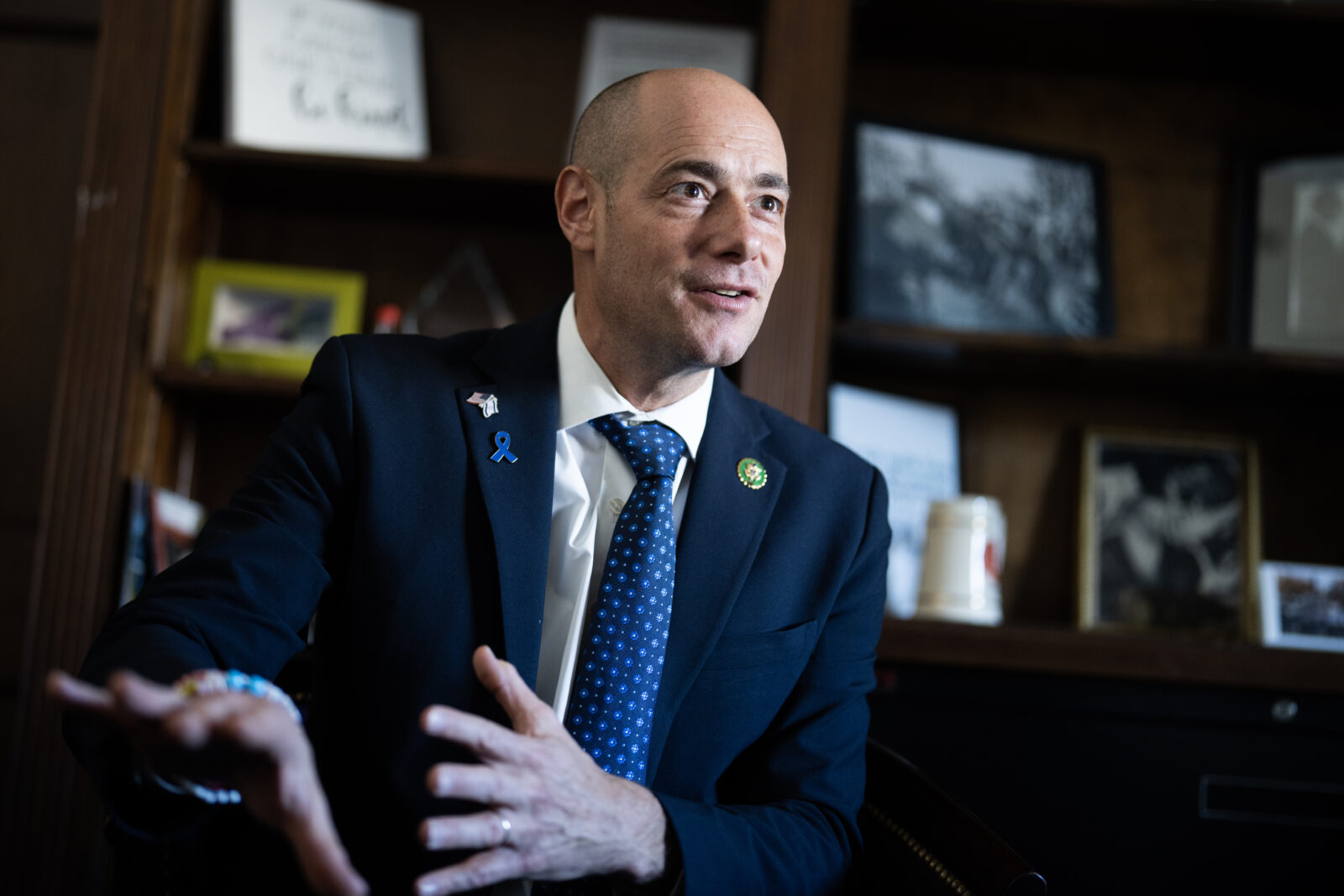
Rep. Greg Landsman (D-OH) has stood apart in recent weeks as one of a small number of congressional Democrats who’ve been supportive of the Trump administration’s strikes on Iranian nuclear facilities.
He argued in an interview with Jewish Insider last week and in a recent op-ed that the Israeli and American show of force, alongside the undermining of Iran’s proxies across the region, could be the key to weakening the Iranian regime to a point where it will agree to a fundamental change of course going forward, unlocking opportunities for regional peace and prosperity. And, he said, it’s critical that the U.S. move forward in a truly unified and bipartisan manner to capitalize on that opportunity.
Landsman told JI he thinks that his Democratic colleagues’ responses to the strikes are motivated by the current political environment, fears about a broader war and concerns about the future of diplomatic talks and the safety of people in the region.
“We’re just in a different political environment than the one I grew up in,” Landsman, 48, said. “The one I grew up in was ‘politics stops at the water’s edge,’ which I loved. … The thinking behind it … is that when we take on these really complicated foreign policy issues, that we do it in a bipartisan way, and that’s not the environment we live in right now.”
He said there’s also a “legitimate concern that it would provoke further attacks or it would instigate a broader war.” Landsman has argued that the current situation is fundamentally different from the run-up to the Iraq war that many skeptics of the strikes have invoked.
Some colleagues, he added, may have also had concerns about compromising diplomatic efforts or “legitimate concerns for people’s safety. But I think for others, and for a lot of folks, it’s just political,” he said.
Landsman said he still hews to the older approach, believing that it’s critical to work toward bipartisan common ground in critical foreign policy questions. He highlighted that the American people overwhelmingly oppose the prospect of an Iranian nuclear weapon.
“I think the American people want [our Middle East policy] to be bipartisan, all of it,” Landsman said. “I think they’re tired of the partisanship in general, but in particular, as it relates to how we resolve these international conflicts and how we take advantage of international or global opportunities, I think they are done with all of this being so partisan.”
He said he still believes a diplomatic solution with Iran is possible and necessary, but said the regime needed to be weakened and see that the U.S. is willing to use force in order to agree to totally dismantle its nuclear program and allow comprehensive international inspections and to dismantle its terrorist proxies .
Unlike some supporters of the strikes, Landsman said he doesn’t think regime change in Iran is the most productive goal, and that the U.S. should instead leverage the regime’s vulnerability for a more favorable deal and fundamental change to the regime’s posture.
“This regime wants to stay in power. If they decide — which they can, and now they’re so weakened that it’s an easier decision for them, and that’s why the strikes were important — they can decide, ‘We’re going to focus on the Iranian people’” and abandon terrorism and their ambitions to destroy Israel, Landsman said. “They could unlock the talent of tens of millions of incredibly brilliant people that have been stuck in Iran under this regime.”
He said that achieving that will “require real engagement and leadership” from both Congress and the executive branch.
Landsman has proposed establishing a bipartisan and bicameral congressional committee to work toward Middle East peace, and argued that the administration needs an expanded team working on the issue, describing Middle East envoy Steve Witkoff as stretched too thin.
“They need to lay out a vision for ending hostilities with Iran and ending the war in Gaza and giving people a sense of what will happen next in terms of peace and stability and security,” Landsman said.
The congressman argued that these issues are too difficult and too important for Congress to be excluded, or to be treated in a partisan manner. He pushed for deep and ongoing executive branch engagement with Congress, not just providing briefings, but in strategizing and building a lasting solution going forward.
Finally putting the Iranian threat to bed would set the Middle East on a fundamentally different course, Landsman argued. “[The Middle East] should be Europe, [if not] for Iran. It hasn’t been able to break out that way because Iran has been the primary obstacle.”
“Getting to a point where Iran is slowly but surely being removed as a threat opens up all the doors,” he said. “It just changes the dynamic for everybody.”
He said he believes leaders across the region see a path toward ending the war in Gaza and the long-running conflicts and building “a Middle East that’s entirely free from terror and countries are working together” and prospering.
In spite of the deep divisions that have increasingly characterized discussions in the United States on Israel and the Middle East since the Oct. 7, 2023, terror attacks, Landsman said he still believes that “the list of what we agree on is way bigger than the list of what folks may disagree on.”
The points of agreement across the American political spectrum include: that Iran cannot have a nuclear weapon; that Iran needs to be subject to stringent inspections; that Iran needs to cease its support for terrorists; that Hezbollah must be disarmed; that the war in Gaza needs to end; that the hostages need to be returned; that Hamas needs to be removed from power; and that international investment in collaboration with Israel and non-Hamas Palestinian leaders is needed to move Gaza forward.
“More international pressure can be brought to bear on Iran and Hamas and Hezbollah and the Houthis to separate them … and say ‘The world has come together. We are going to pick the side of those who want to rebuild the region and rebuild it free of terror and corruption,’” Landsman said. “Ultimately, when you have the kind of security that any country would need and expect, then you get back to the negotiating table.”
Landsman has spoken on multiple occasions in recent months about his aspirations for an abiding peace in the Middle East, a vision that he says is driven by a lifetime of connection and passion for Israel and the region.
He said his Jewish upbringing had inculcated in him a sense of connection to the importance of Israel for the Jewish people.
Landsman said that efforts to negotiate between Israel and the Palestinians were also a constant feature of his youth, and that he believes that there is still broad agreement on the goal of a durable peace that can provide security for Israel and self-determination and self-governance for the Palestinians.
A Harvard Divinity School graduate, the Ohio congressman has visited Israel numerous times as a lawmaker, but also traveled there frequently and built connections in his previous work in education advocacy. After implementing new preschool programs in the Cincinnati area, Landsman was asked to help work with Ethiopian Israelis to improve educational outcomes, an effort that grew between 2015 and 2020.
He said his time on the ground in Israel showed him that Jews and Palestinians “have a lot in common” — shared history, a shared home and common experiences of expulsion and rejection. And it highlighted to him the extent to which Arab Israelis are part of and integrated into Israeli society.
“I have built up this legitimate affection and love for these two communities of people that, because of circumstance, have been fighting,” Landsman said. “Ending that would transform everything — not just their lives, but the region and the world.”