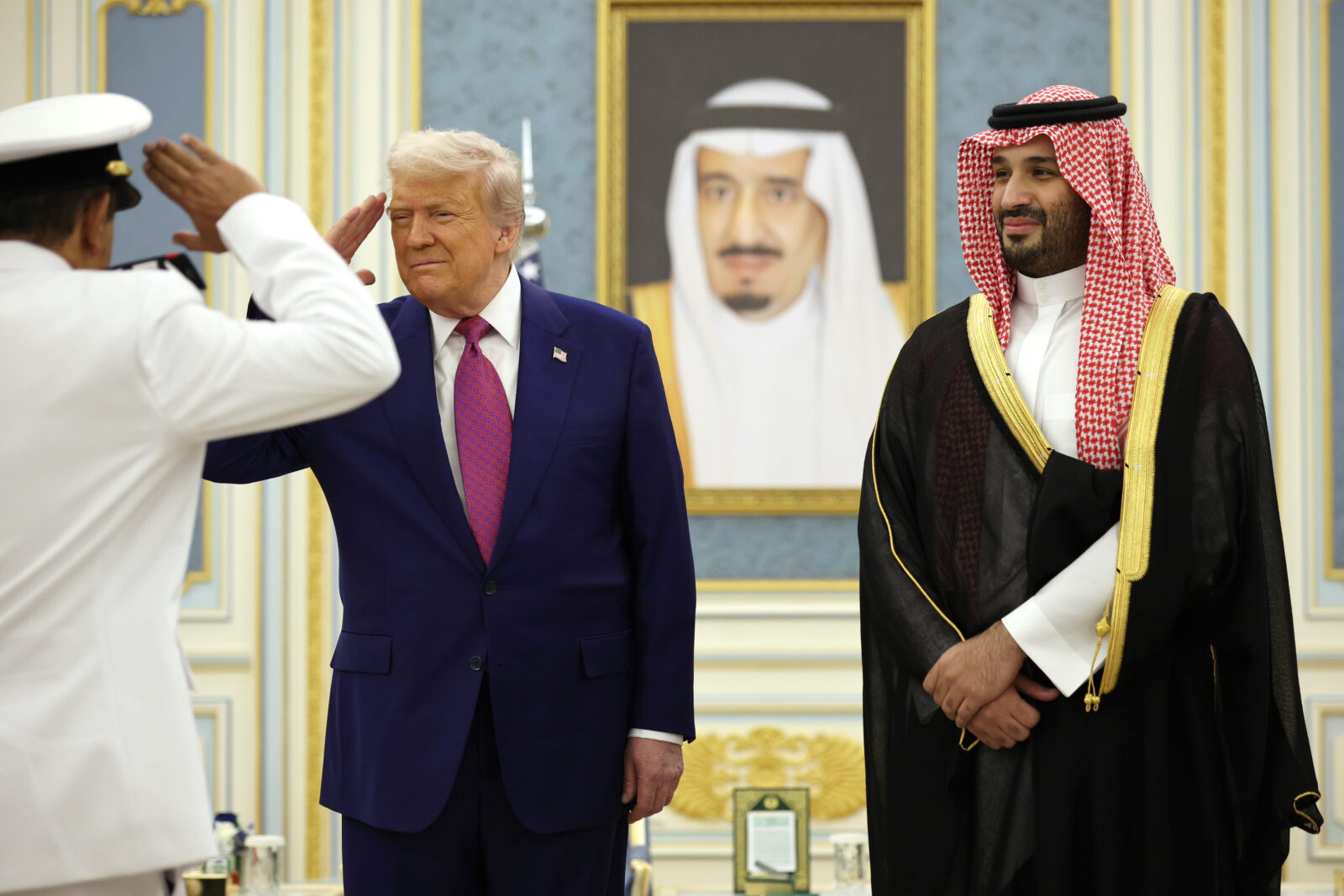
Win McNamee/Getty Images
After Iran strikes, Saudis in no rush to join Abraham Accords, experts say
With no long-term ceasefire in Gaza and a strategy of trying to contain and balance Iran’s power in the region, the Saudis are in no rush to normalize relations with Israel, experts told JI


 Add JewishInsider on Google
One of the original drivers of the 2020 Abraham Accords, in which the United Arab Emirates and Bahrain normalized relations with Israel, was Israel’s vocal, public stance against Iran’s nuclear program and regional aggression. That stance also brought Israel and Saudi Arabia closer, a relationship that developed to the point that in the summer of 2023, it seemed like normalization was just around the corner — which officials, including former Secretary of State Tony Blinken, have since confirmed.
By extension, it might make sense for the Abraham Accords and a Saudi-Israel rapprochement to be back in the headlines after Israel took the ultimate stand against Iran’s nuclear program last month, bombing it with assistance from the U.S. President Donald Trump has expressed hope to expand the accords in recent weeks, ahead of and during his meetings with Israeli Prime Minister Benjamin Netanyahu last week.
Yet there has been almost no serious talk about Saudi Arabia joining the Abraham Accords in recent weeks.
Riyadh has also been publicly signaling that its relationship with Tehran is still on track since China brokered a deal between the two countries in 2023. Saudi Arabia, like other Gulf States, spoke out last month against the Israeli and American airstrikes on Iran. Last week, Iranian Foreign Minister Abbas Araghchi met with Saudi Crown Prince Mohammed bin Salman in Jeddah.
With no long-term ceasefire in Gaza and a strategy of trying to contain and balance Iran’s power in the region, the Saudis are in no rush to normalize relations with Israel, experts told Jewish Insider.
Bernard Haykel, a professor of Near Eastern Studies at Princeton University, told JI that the Saudis’ statements came out of a fear that “if Iran is attacked by Israel and the U.S., the Iranians would retaliate against them … The public statements are all basically defending Iran’s right as a sovereign state to get the Iranians not to see them as an ally or a proxy of America and Israel.”
But, “in fact, they are allies of America,” he added.
“There’s all this public condemnation of the attacks on Iran,” Haykel said, “but when the U.S. pulled its forces from the Air Force base in Qatar [due to Iran’s retaliation], they moved their planes to a Saudi base. So they condemned the U.S. for attacking Iran, but they also gave the U.S. protection.”
In addition, he noted, Saudi Arabia is in CENTCOM, as is Israel, such that if any Iranian drones or missiles were detected over Saudi territory, the information would be relayed to Washington and Jerusalem. “It is a fact that [the Saudis] are part of a security architecture that protects Israel as much as it protects them.”
Haykel said there is a sense of relief in Riyadh from how the 12-day Israel-Iran war played out, but Saudi officials are still concerned about Iran’s remaining ballistic and cruise missiles: “[Iran is] very close and can swarm Saudi Arabia. Unlike Israel, the Saudis don’t have an Iron Dome. They’re much more vulnerable.”
The meeting between bin Salman and Araghchi is “part of the strategy to protect themselves from an Iranian attack,” Haykel added.
Hussein Aboubakr Mansour, a senior fellow at the Jerusalem Center for Security and Foreign Affairs and a researcher at the Institute for the Study of Global Antisemitism and Policy, told JI that “the Gulf states are immediate neighbors of Iran and will always have to live with them.”
“Iran will always be a problem for them no matter who is in power. It is a huge, advanced state, and they are these tiny Gulf states. They can’t stop Iran’s ambition and wish for hegemony,” he said.
Aboubakr Mansour argued that the Saudis have an interest in keeping the current Iranian regime in place, because a more liberal Iranian regime may turn itself into Washington’s favored Middle Eastern power, as it was in the 1960s and ‘70s, threatening the close relationship Riyadh has with the Trump administration.
“They have an interest in Iran remaining the pariah that it is,” he said.
Haykel said that the Saudis “are not going to shed tears for Iran, regardless of their public statements.”
“They sound like they’re anti-Israel, but in actual fact, the Israeli military capability that has been on display vis-a-vis Iran, the attack on the Iranian nuclear facilities and the Israeli capability to defend itself from Iranian attacks are all things the Saudis want,” he added. “They want an Iran chastened, that doesn’t use non-state actors and doesn’t have a nuclear program. They want a contained Iran.”
Saudi Arabia’s strategy has been “trying to get Iran to behave more responsibly,” rather than as a “hugely destabilizing factor in the region through its proxies,” Haykel said. That was also the motivation behind the 2023 China-mediated detente between Saudi Arabia and Iran, he explained.
Aboubakr Mansour said that balancing the other major powers in the Middle East — Iran, Israel and Turkey — is a priority for Riyadh.
A decade ago, “standing up to Iran was one of the main attractions of Israel [for the Saudis], that was true then,” Aboubakr Mansour said. “Now there’s a main factor they need to calculate, that the U.S. is not reliable and maybe it isn’t going to be again … [The Saudis] had four good years with Trump and the Abraham Accords, and then the Biden administration [and the Saudis] couldn’t stand each other.”
In addition, he said that the Gulf states “have a complete lack of hard power compared to Israel, Iran and Turkey,” and bin Salman has big ambitions for his country and its economy.
“All of these elements together lead them to calculate their national interests and strategy in a way that gives them maximum leverage over everyone all the time,” he said. “It’s about balancing everyone against everyone else … The Saudis’ ambition is huge and they can’t allow the Iranians, Turks or Israelis to become a hegemonic force in the region.”
As such, Aboubakr Mansour posited that “the Saudis are in a place where they want to see neither the Israelis nor the Iranians win. [The Saudis] want them to put each other in check, which will give [the Saudis] more leverage.”
As for what the means for Saudi-Israel normalization, Aboubakr Mansour argued that “the Saudis are comfortable playing the normalization game for as long as they can … because they can gain more from their current position than actually normalizing.”
Normalization talk gives the Saudis positive attention from the media, attracts investment and makes them look better in Washington, but “it’s a good show. There’s no reality to it,” Aboubakr Mansour said.
“They cooperate with the Israelis — they have a new class of statesmen who are [Millenials], they are not interested in the ‘resistance’ and see the positive in Israel — but interests dictate everything. They will play the game as long as they can extract more leverage from it … Normalizing with Israel doesn’t have the incentives for the Saudis that it did five years ago,” he said.
Haykel similarly said that “the Saudis are very good at temporizing, kicking the can down the road until they feel the time is right,” he added.
The Saudis “have their own constraints — domestic, regional and the Islamic public – that they have to keep in mind,” Haykel said. “They are insisting first and foremost on a ceasefire … They seem to be talking less about irreversible steps towards Palestinian statehood, but I think it is still a condition for normalization.”
Still, he said, “Palestinian statehood is seen in Israel as rewarding terrorism and not something the Israeli public is willing to entertain at the moment, and the Saudis know this well.”
Because of that, the Saudis have been “pushing for more cosmetic things … [such as] working with France to get as many states as possible to recognize a Palestinian state through the U.N.”
According to Haykel, the Saudis want to be able to say that a solution for Palestinian self-determination has been found, without making specific demands of what that means, whether the Palestinians would have an army or not, or if they would have full or partial sovereignty.
In that regard, not much has changed since Oct. 7, 2023, in that the Saudi leadership “never had much respect for the Palestinian Authority, with a few exceptions,” and as such, Riyadh does not want to be saddled with the bill for Gaza’s reconstruction because they do not think the PA is up to the task, Haykel said.
“They want some kind of face-saving solution with the ceasefire being a precondition,” he said. “They’re waiting for President Trump to put pressure on Netanyahu to reach a ceasefire and then make gestures toward the Palestinians.”
At the same time, Haykel warned that there is some talk in Riyadh of pushing for a U.N. Security Council resolution that would enshrine a right for the Palestinians to have sovereignty over the West Bank and to have a capital in east Jerusalem. The idea, he said, came from former PA Prime Minister Salam Fayyad.
“They would like the U.S. to push for this regardless of what Israel says or thinks or does,” he added, “but they have not moved to do this yet.”
Meanwhile, the only recent public movement toward Israeli-Saudi normalization was the appearance last week of Saudi journalist Abdulaziz Alkhamis in the Knesset for a meeting of the Caucus to Advance a Regional Security Arrangement.
Alkhamis said that the Oct. 7 terrorist attacks and subsequent war, along with the Israeli strikes on Iran, are a sign that the region’s “tectonic plates” are moving, and that Israel exposed Iran’s strategic limitations. However, he emphasized that “normalization, from a Saudi point of view, is not just a bilateral agreement. It is a regional alignment and must include a credible, irreversible path to Palestinian sovereignty.”
Former Israeli Defense Minister Benny Gantz said in the caucus meeting that “there is too much weight given to the Palestinian matter and it is being turned into [an excuse] to stay in place. We must be daring and make advances — we must, but we should also demand this courage from neighboring countries that want to advance normalization.”