








































Josh Shapiro and the politics of faith
The potential 2028 presidential candidate spoke candidly about his faith in two recent high-profile interviews
Andrew Mordzynski/Icon Sportswire via Getty Images
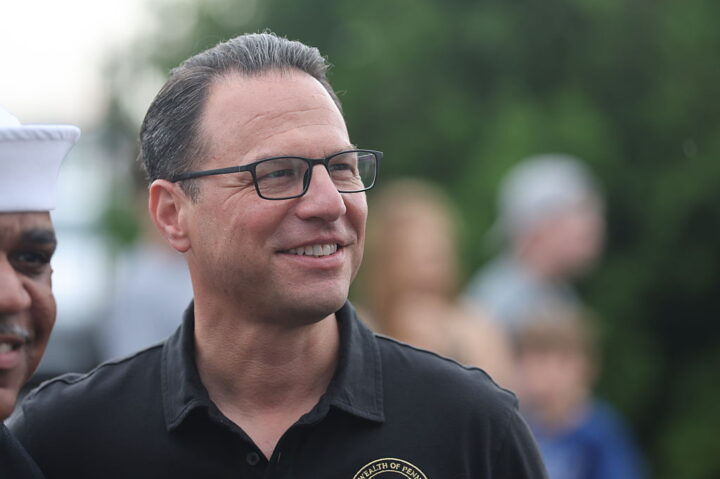
Pennsylvania Gov. Josh Shapiro looks on during the NASCAR Cup Series at The Great American Getaway 400 on June 22, 2025, at Pocono Raceway.


 Add JewishInsider on Google
The 2028 presidential race is still well over a year away from beginning in earnest. But if there’s any indication about whether Pennsylvania Gov. Josh Shapiro, long considered a rising star in the Democratic Party, is seriously considering running, it’s that the moderate swing-state governor recently sat down for interviews for two major magazine features — in The Atlantic and The New Yorker — both published in the last week.
Shapiro faced questions about his ambitions, his successes and failures and his take on the increasingly divisive and vitriolic nature of American politics. The two interviews also offer a fresh look at how Shapiro, one of the most prominent Jewish politicians in America, thinks about and practices Judaism from his perch in Harrisburg.
When he ran for governor in 2022, his first major campaign ad featured footage of him and his family observing Shabbat. He told The Atlantic’s Tim Alberta that Friday night dinners are “still a sacrosanct moment for our family.” But he also shared that he and his family have lately attended synagogue services “far less than at any other point in our lives.”
Shapiro regularly invokes religion in public addresses, choosing to speak about “my faith” rather than more specifically referring to his Jewish faith.
“I feel more connected to my faith today than at any other time in my life. Truly. And I probably pray more now than at any other time in my life. But my connection to an institution of prayer, or a sort of formal structure of that prayer, has dramatically decreased,” Shapiro shared. “The sort of ritualistic practices became less of a focus of the way we practice our faith — with the exception, of course, of Friday nights.”
In conversation with The New Yorker’s Benjamin Wallace-Wells, Shapiro opened up about the arson attack on the governor’s residence in April, hours after his family had concluded their Passover Seder. At the October sentencing hearing for the assailant, Shapiro said for the first time that he may have been targeted, in part, for his Jewish faith.
“The prosecutor felt it was important to introduce into evidence the bomber’s claims that he did that because of ‘what I did to the Palestinians,’ so clearly there was some motivation because of my faith,” Shapiro told The New Yorker, which reported that the dining room — now restored after being severely burned — features a small display of charred cups and dishes from the Seder, to remember that frightening evening.
But Shapiro’s subsequent comments backed away from personally tagging an antisemitic motive on the perpetrator: “I think it is dangerous for you or anyone else to think about those who perpetrate these violent attacks as linear thinkers, meaning that they have a left-wing ideology or a right-wing ideology, or that they have a firm set of beliefs the way you might or I might. These are clearly irrational thinkers.”
Shapiro talked to The New Yorker about rising antisemitism in the U.S., and said that he disagreed with President Donald Trump’s handling of antisemitism. Trump “is using Jews as his excuse for trying to take over universities and restrict their funding,” Shapiro said. But he does not deny that Jewish students were targeted, sometimes violently, on American campuses after the Oct. 7 attacks. “These are crimes,” Shapiro said. “And to me, that’s where a line was crossed.” He flexed his gubernatorial power to pressure the University of Pennsylvania — albeit indirectly — to crack down on antisemitism.
Ultimately, as Shapiro continues in a political career that has so far only taken him higher, often with great momentum, he will face a question beyond just who is the best candidate in 2028: Can a Jewish person get elected president in the U.S.? The Atlantic asked Shapiro directly.
“There aren’t a whole lot of folks who pray like me,” Shapiro acknowledged. But, he added, “I have found that by living openly and proudly with my faith that it’s brought me closer to the people of Pennsylvania. And I think the people of Pennsylvania are pretty indicative of where large swaths of the American people are.”
More Stories

chant controversy
Zohran Mamdani says ‘globalize the intifada’ is expression of Palestinian rights
blake's backtrack
In 2020 AIPAC position paper, Michael Blake vowed to support Israel, highlighted Black-Jewish unity

on the agenda
Trump meeting with Netanyahu at Mar-a-Lago later this month
TEXAS TALK
Two Republicans condemned by Jewish groups looking to make comebacks in Texas

doha forum dispatch
Hillary Clinton reiterates concerns about anti-Israel ‘propaganda’ targeting American youth