















Jewish leaders, lawmakers, scramble to protect synagogues amid threatening anti-Israel protests
New York state legislators are considering legislation that would establish a 25-foot buffer zone outside houses of worship
Selçuk Acar/Anadolu via Getty Images
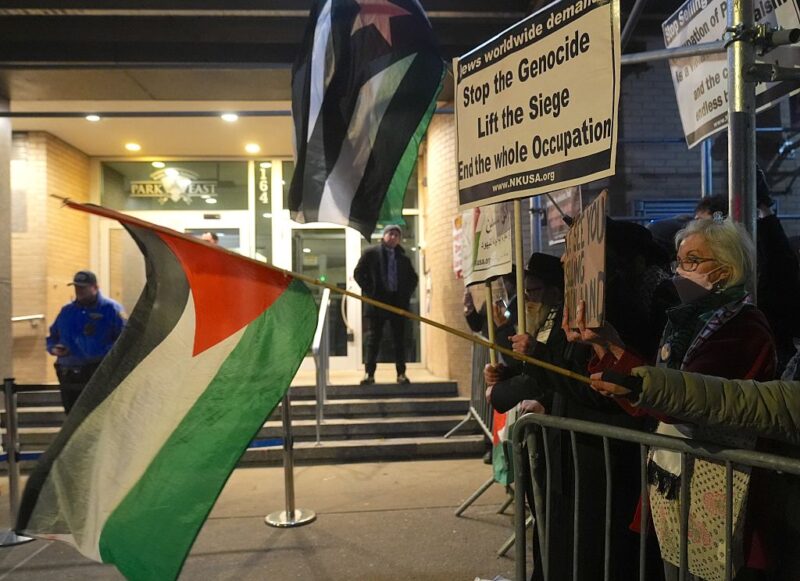
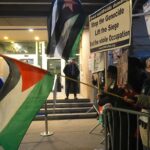
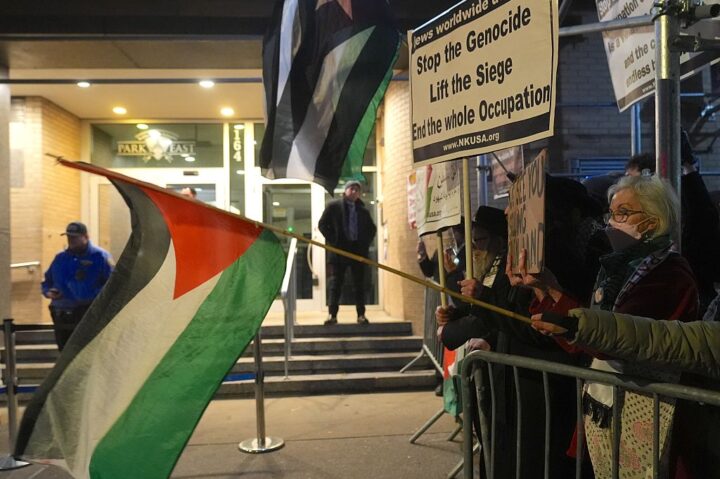
Anti-Israel demonstrators gather at 'No Settlers on Stolen Land' protest against a Nefesh b'Nefesh event at the Park East Synagogue in Manhattan in November 2025.


 Add JewishInsider on Google
As anti-Israel demonstrators increasingly target synagogues in protests that have turned violent and used antisemitic rhetoric, some Jewish leaders and state lawmakers are now calling for more expansive legislative safeguards to help bolster protections for houses of worship.
The new efforts have come in the wake of threatening behavior outside synagogues in New York City and Los Angeles that drew forceful condemnation from elected officials and raised concerns among Jewish leaders who fear that such incidents will normalize antisemitic harassment disguised as anti-Zionism.
In New York, state lawmakers this week introduced a new bill to ban protests directly outside houses of worship. The legislation seeks to amend the existing state penal law by establishing a 25-foot buffer zone around religious sanctuaries to insulate congregants from facing intimidation and potential clashes with demonstrators that have occurred more regularly in recent years.
The bill, which would also apply to abortion clinics, was advanced in response to a controversial protest last month outside Park East Synagogue, a Modern Orthodox congregation in Manhattan, where about 200 activists disrupted an event educating attendees about immigration to Israel while chanting slogans including “death to the IDF” and “globalize the intifada,” interpreted as calls to violence against Jews.
“We’re in a very troubled time, and that’s going to mean we need to adapt, including with legislation,” Micah Lasher, an assemblyman in Manhattan who introduced the legislation with a fellow Jewish state senator, Sam Sutton, told Jewish Insider on Thursday.
He said that he had weighed free speech concerns while drafting the bill to protect “the right of people to speak out, even when that speech is hateful, with the right of people to express their religion freely.”
“We’re going to see more and more of this until we can more broadly curb antisemitism,” he cautioned, calling the protest in Los Angeles this week, which ended in the arrests of two demonstrators, “a harbinger of things to come” in the absence of further legislative action.
Nily Rozic, a Democratic assemblywoman from Queens who is co-sponsoring the bill, echoed that view. “Houses of worship should serve as peaceful sanctuaries, not punching bags for protesters,” she explained. “Following incidents in NYC and LA, it’s becoming apparent that creating no-protest zones outside houses of worship is absolutely necessary.”
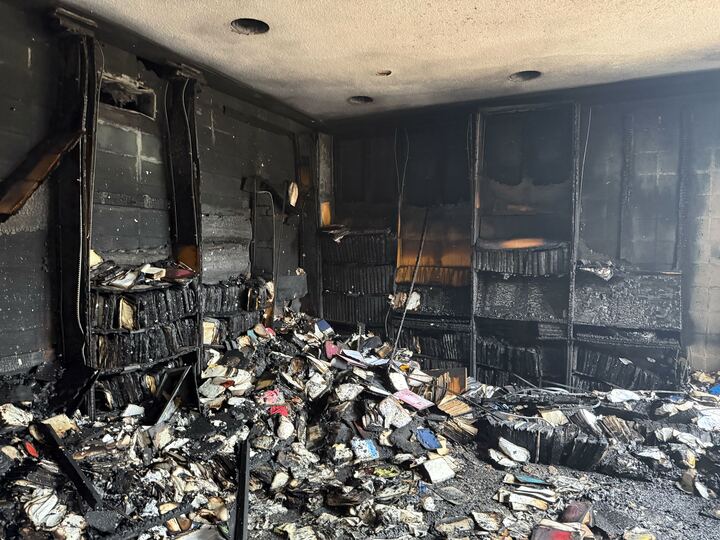
In contrast with the incident in New York City, the protest that erupted in Los Angeles on Wednesday was more intrusive, with video showing anti-Israel demonstrators shouting inside the historic Wilshire Boulevard Temple — where one activist shattered a vase during a public safety event held with Korean community members.
Jewish community activists in California said they viewed the incident, coupled with the recent protest in New York City, as an impetus to take a closer look at state law relating to such demonstrations.
Julia Mates, the director of policy and government affairs at Jewish Community Relations Council Bay Area, said that the state already has an existing law that protects access to houses of worship as well as abortion clinics — similar to the federal Freedom of Access to Clinic Entrances Act, which has been used by the Justice Department under President Donald Trump to target protesters charged with disrupting Jewish spaces.
Mates said that her organization last year had “started to reexamine the act” with an eye toward potentially expanding what she called the “bubble zone” protecting congregants, but tabled that effort in favor of focusing exclusively on legislation aimed at countering antisemitism in public schools.
But now, in light of recent events, “it might be a good time to reexamine a fixed distance rule and gaps in enforcement,” she told JI on Thursday.
“The environment is such that we need to take another look at this,” Tyler Gregory, CEO of the Bay Area JCRC, vowed. “This is getting a lot of chatter in the community. I think that Jewish legislators and organizations haven’t figured out where we want to land yet,” he continued. “But it’s certainly the topic du jour.”
Noah Farkas, who leads the Jewish Federation of Los Angeles, said that his organization, for its part, has “been pushing for” legislation to more forcefully regulate such demonstrations “for a long while.”
“While we recognize the right of anyone to assemble lawfully to express themselves,” he explained to JI Thursday, “it should not endanger the lives or limit the liberty of anyone else. And while this is a matter on a legal and political level of balancing one set of rights next to another, there is yet a deeper strain of values that needs to be addressed.”
Rep. Laura Friedman (D-CA), a Jewish Democrat from Los Angeles, said the Wilshire demonstration was “deeply personal,” noting that she had attended services at the synagogue during the High Holidays.
“At a time of surging antisemitism, no one should have to choose between their safety and their right to worship,” she said in a statement shared with JI. “I’ll always protect free speech, but when protests cross into criminal intimidation, threats or blocking access, authorities must step in to uphold the law and protect Americans’ right to gather and worship without intimidation.”
Julie Fishman Rayman, senior vice president of policy and political affairs at the American Jewish Committee, called the Los Angeles protest “horrific and beyond unacceptable,” while citing legal “tools that already exist and should be used to maximum impact” in order to hold anti-Israel demonstrators accountable.
As Jewish community activists are now considering efforts to strengthen such laws, Lasher said his new legislation “strikes the right balance” on free speech and safety issues, and “could potentially be a model for other states.”
“For as long as we’re dealing with these sorts of hateful events,” he said, “we should make sure we are giving appropriate tools that are constitutional to enable people to enter synagogues without fear of intimidation.”
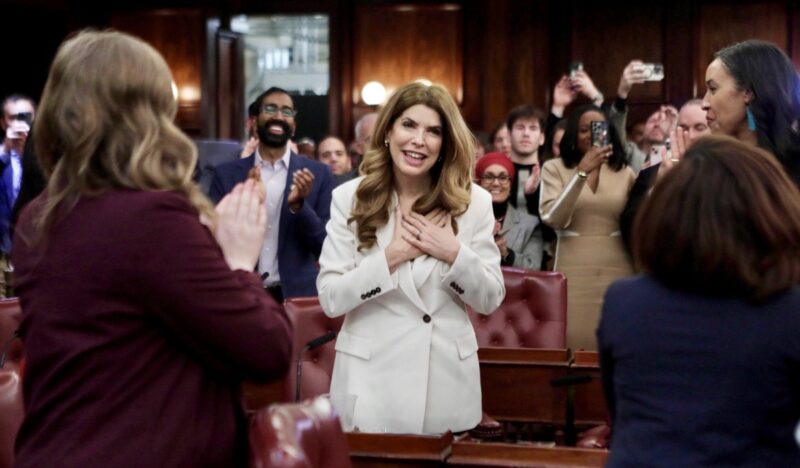
New York Gov. Kathy Hochul, a Democrat, voiced interest in supporting the bill on Thursday, saying that she was “willing to look seriously at a buffer to protect that fundamental right we have, which is to express ourselves and practice the faith we choose to without fear and intimidation.”
“I don’t say whether or not I’ll support bills,” she told reporters, “but if it shows up in another place, I’m taking that very seriously. I think it’s time. I will be supportive of that.”
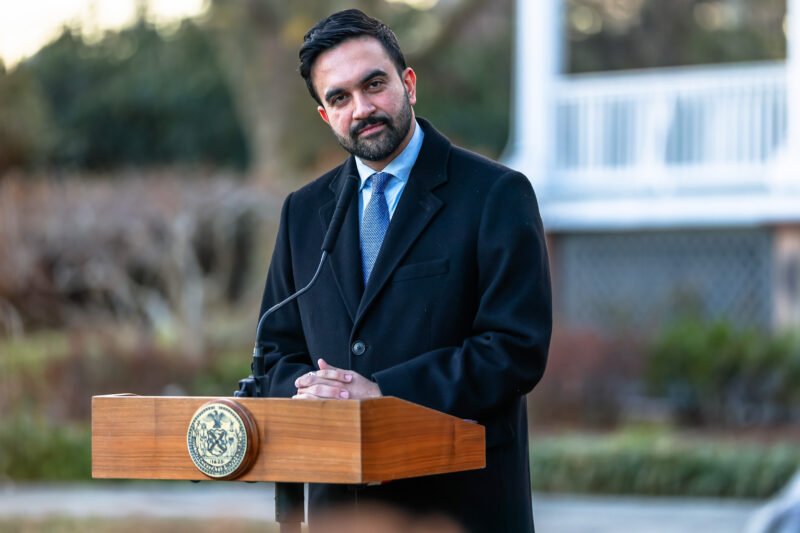
Zohran Mamdani, the mayor-elect of New York City and a democratic socialist long vocally critical of Israel, has also expressed interest in learning more about such legislation, after he had faced backlash for accusing the Park East Synagogue of promoting activities “in violation of international law,” even as he sought to distance himself from the protesters.
Mamdani’s team did not respond to a request for comment from JI about the newly proposed bill.
More Stories
ON THE HILL
2026 defense bill includes unconditional repeal of Syria sanctions, Iraq war authorizations
Fuentes’ following
New report documents foreign engagement driving online antisemitic activity

chant controversy
Zohran Mamdani says ‘globalize the intifada’ is expression of Palestinian rights
HEZBOLLAH HIT
Israel kills Hezbollah chief of staff in Beirut airstrike

exclusive
Schumer, Senate Democrats introduce resolution condemning Fuentes, Carlson