



















































Longtime Jewish activist mounts bid for D.C. congressional delegate seat
‘I’m fighting for D.C. with a spirit that I learned fighting for the Jewish community,’ Kinney Zalesne told JI
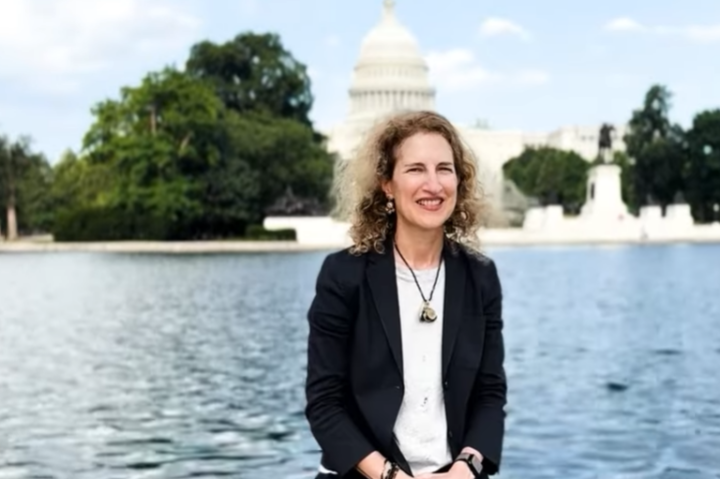
Campaign website
Kinney Zalasne


 Add JewishInsider on Google
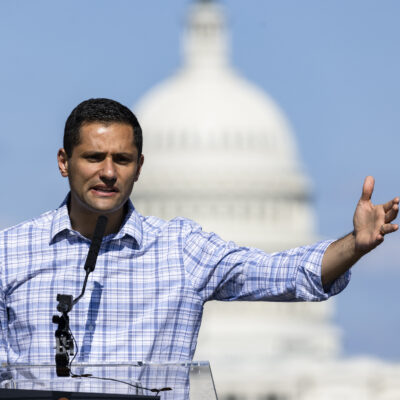
Kinney Zalesne, a longtime Jewish community activist, is one of a slew of Democratic candidates mounting a bid to unseat the District of Columbia’s longtime nonvoting representative to Congress, Del. Eleanor Holmes Norton (D-DC).
Holmes Norton, 88, has come under increasing scrutiny in recent years, with mounting questions about her age and her continued capability to perform in her job, which have been fueled by conflicting statements from Holmes Norton and her own staff about whether she plans to seek reelection in 2026. Her muted response to the Trump administration’s efforts to exert control over the District has further stoked criticism.
Zalesne, 59, said she’s running for the seat because “America is in the greatest danger in my lifetime, and D.C. is on the front lines.”
She said she has a “lot of respect” for Holmes Norton and that the incumbent has done “a lot of very important things for the city and was an important player on the national level,” but that D.C. now faces “different” challenges and the “stakes are high.”
“It’s a new era, and we need a new, fresh voice who can carry on her same, relentless advocacy,” she continued.
Zalesne grew up in a Conservative synagogue in Philadelphia, learning to read Torah at age 16 and lead services at 25. She said she’s been doing both ever since, including leading Mincha services on Yom Kippur annually for 32 years — a fact she said would distinguish her from any other Jewish member of Congress.
She also served as a board member and board chair of D.C.’s Jewish day school, serves on the American Board of the National Library of Israel and advised two hostage family groups, as well as worked with a group of Israelis trying to convene a constitutional convention prior to the Hamas terror attacks on Oct. 7, 2023.
“My run for office is really motivated by my Jewish sensibility,” she said. “My whole career has been about expanding opportunity for people, and that, to me, has always felt like that’s always been a huge part of my Jewish identity, and so this run for Congress is really an extension of that.”
She said she sees parallels between the city of D.C. and the Jewish community: “At the moment, we’re both under attack. We’re both small but mighty groups of people. And we both have so much to contribute and an impressive capacity to lead, so long as we’re not mistreated. And at the moment, we’re both … nervous and we’re vulnerable. I’m fighting for D.C. with a spirit that I learned fighting for the Jewish community.”
Zalesne highlighted that Jewish representation in the House has dropped precipitously over the past two decades, a poor omen at a time when antisemitism is also rising.
“As the D.C. delegate, I will stand strong against antisemitism wherever I see it,” she said. “We see it on the far right, we see it on the far left. I will call it out anywhere I see it. … It’s a terrible trend in our country, and we need more Jews in public life, not fewer.”
Antisemitic violence, she noted, hit at the heart of D.C. earlier this year with the slaying of two Israeli Embassy employees outside the Capital Jewish Museum, and “it will be a priority for me to guard against early warning signs and explicit manifestations of antisemitism.”
Though the D.C. delegate does not have a vote on congressional legislation, Holmes Norton has nonetheless made her voice heard on foreign policy issues in other ways, supporting various efforts and policies critical of Israel.
“I am deeply committed to a strong U.S.-Israel relationship, both because Israel is our strongest ally in the region, and because that strong relationship is in the United States’ national security interest,” Zalesne said.
She said she supports President Donald Trump’s peace plan for Gaza and praised Trump’s efforts in bringing it to fruition, but said it will be a long process to rebuild Gaza and remove Hamas from power. “I’m committed to that progress for the dignity and safety and security of everyone in the region.”
The mother of three college students and one recent college graduate, Zalesne said that she is worried about the “profound antisemitism problem on many campuses.” But she added that she’s “not persuaded” that the Trump administration’s policies, such as suspending funding to campuses, “really had anything to do with antisemitism.” She said it appeared to be fueled more by an “animus toward liberal arts” and a desire to force colleges into submission.
She argued that the Republican Party has to confront antisemitism in its own ranks, and that a proper approach to antisemitism on campus would be more targeted, rather than mass defunding research programs at prestigious universities.
“Their approach was way too crude, way too overblown, not targeted, not strategic and leads one to believe that antisemitism was something of a pretext in their solution. … The solution was not actually designed or narrowly tailored toward that problem,” she said. “As is often the case with Trump, he identifies a real problem, but then the solution is so over-broad and ideological and mismatched to the problem that people end up saying, ‘Well, there never really was a problem,’ and that’s wrong.”
She said she’s also worried that the Trump administration’s approach is going to “backfire,” make campus antisemitism worse and exacerbate on-campus tensions.
Asked about recent shifts in Democratic policy on Israel, Zalesne said that the party “has some work to do internally to be able to be a big tent, but not so big that we include policies and positions that are either antisemitic or harmful to minorities in the United States or elsewhere.”
She said that she would not support efforts to block offensive weapons sales or transfers to Israel, suggesting that such moves might make Israelis and Americans less safe, but she said the U.S. should use its influence over the Israeli government “toward peace, security and dignity for everybody in the region.”
Zalesne said the U.S. should “continue to be a strong voice, a strong influence in the region, to support the incredibly important U.S.-Israel relationship, and always back and guarantee the safety and security of Israel, and to work toward a dignified and economically prosperous future for Palestinians.”
She also said she supported the Trump administration’s decision to carry out military strikes on Iran in June, adding that Israel was also right to launch attacks on Iran’s nuclear facilities.
“I don’t agree with Donald Trump on much, but I was grateful for that move,” she said. To prevent Iran from rebuilding, Zalesne said the U.S. needs “constant vigilance and determination to act as needed” in the future, and to convey to the world that the U.S. “won’t permit a nuclear Iran.”
In addition to her work in the Jewish community, Zalesne worked in the White House and the Justice Department in the Clinton administration, started a nonprofit in D.C’s Adams Morgan neighborhood to support local first-generation college students and served as a deputy national finance chair for the Democratic National Committee.
After the 2024 election, she said that she “realized [the state of the country is] getting worse, not better, and no one is coming to save us, and we have to be the leaders we wish we had, so I decided to step up myself,” Zalesne told JI.
Zalesne was recently endorsed by former DNC Chair Jamie Harrison.
The candidate said she envisions a “bigger” role for the D.C. delegate than it has had in the past.
On the Hill, she said she’ll focus on traditional issues like protecting D.C.’s budget — which was slashed by Congress earlier this year — and protecting D.C’s autonomy.
Zalesne said that she wants to expand the delegate’s role off the Hill as well. She wants to work to “get the message about D.C. out and bring resources in,” by communicating to the whole country “the truth about who we are and what great strength we bring to the nation.” She said she also wants to work to bring in leaders from national business and philanthropic communities to work in the district.
She also argued that she’s the only candidate in the race with both the local and national experience and relationships to “deliver for D.C. on Day 1.”
Zalesne’s campaign says she’s breaking district records with her fundraising efforts — she raised $436,000 as of the end of September, many multiples of the $51,000 that Holmes Norton raised. But she’ll also be facing down several well-known D.C. city leaders who have entered the race since the last filing period.
But internal polling by D.C. City Councilmember Robert White’s campaign last month found Zalesne near the bottom of the pack, with just 1% support.
More Stories
MICHIGAN MOVES
Haley Stevens maintains support for Israel as her primary rivals battle over anti-Israel lane

HEZBOLLAH HIT
Israel kills Hezbollah chief of staff in Beirut airstrike
eye on the prize
Virginia lawmaker with history of anti-Israel rhetoric eyes 2026 congressional run

JOHNSON'S JOURNEY
House Speaker Mike Johnson headed to New Square on Sunday to help Mike Lawler

BUDAPEST BEAT
The Orthodox Jewish GOP donor vying to be U.S. ambassador to Hungary