
































Over half of House Republicans call for accountability on Syria sanctions repeal
The GOP pushback indicates that a significant number of Republican lawmakers remain concerned about the Syrian government’s conduct

Kevin Carter/Getty Images
The U.S. Capitol Building is seen at sunset on May 31, 2025 in Washington, DC.


 Add JewishInsider on Google
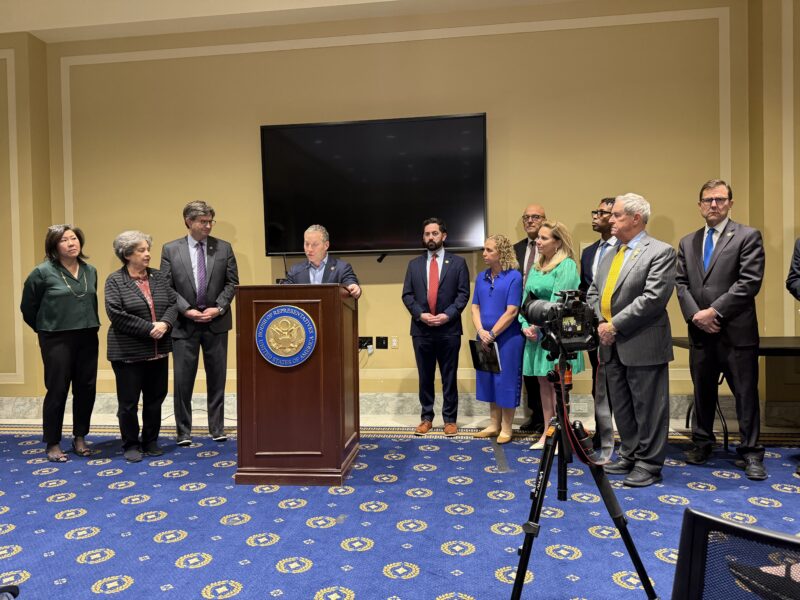
A group of 136 House Republicans released a joint statement on Friday calling for increased oversight of and accountability from Syria, days after voting to repeal the last major sanctions package on the country as part of the 2026 National Defense Authorization Act.
The Trump administration had pushed Congress to repeal the so-called Caesar Act sanctions, an action finalized when Trump signed the 2026 NDAA Thursday evening, but some lawmakers on the Hill have harbored continued reservations about the new government in Syria and ensuring it continues to make progress on democracy building.
The statement indicates that a significant number of Republican lawmakers remain concerned about the Syrian government’s conduct going forward. It follows an attack by ISIS affiliates who also reportedly had ties to the Syrian government that killed two U.S. service members and a civilian interpreter in Syria last weekend. The statement has been in the works since last week, shortly after the House voted to pass the NDAA, a source familiar with the situation told Jewish Insider.
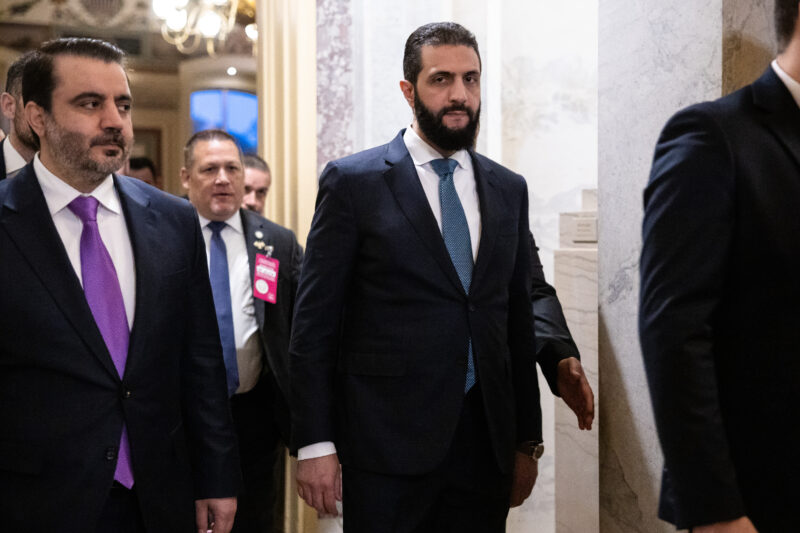
“Bringing religious freedom into Syria is the only way the country will fully stabilize. The sanctions repealed by the NDAA will help economically, but violence will not cease until [Syrian President Ahmad] al-Sharaa uses his position to denounce religiously motivated attacks,” Rep. Marlin Stutzman (R-IN), a co-lead of the joint statement, told Jewish Insider.
The lawmakers, led by Stutzman and Rep. Josh Brecheen (R-OK), said in the joint statement that members of Congress interested in protecting religious minorities in the region “worked with the Trump Administration and House leadership to secure assurances that snapback conditions … would be enforced if Syria does not comply with the terms highlighted in the repeal language.”
The NDAA includes language calling for the administration to reimpose sanctions on Syria if a variety of human rights, security and anti-corruption conditions are not met, and for reporting to Congress on those benchmarks — but the language is not binding and the strict and sweeping Caesar Act sanctions could not be reimposed by executive authority without another act of Congress.
The lawmakers said that the “the mass murder of the Syrian Christians, Druze, Alawites, Kurds, and other religious and ethnic minorities must be a thing of the past” and that they are “committed to keeping a watchful eye on the new al-Sharaa Administration to ensure protections for religious and ethnic minorities.”
They said they would like to travel to Syria to see firsthand that religious protections are being upheld, particularly in Suweida, the city with a substantial Druze population where government-aligned forces carried out mass atrocities earlier this year.
“We look forward to confirming that these terms have not been squandered by the Syrian government — whether by their president or by rogue military officials — and seeing for ourselves that the al-Sharaa Administration has created a safe environment for the religious and ethnic minorities historically persecuted in the region,” the statement continued.
The lawmakers also said that House Speaker Mike Johnson (R-LA) and House Foreign Affairs Committee Chairman Brian Mast (R-FL) had agreed to hold a hearing on “the verified change of treatment for religious minorities in Syria.”
Mast himself, who had been the last major roadblock on the Hill to sanctions repeal and pushed for the nonbinding snapback language to be included, is one of the first signatories on the statement.
Sen. Jim Risch (R-ID), the chair of the Senate Foreign Relations Committee, said in a statement that the “unconditional” sanctions repeal is a significant step, while highlighting the congressional oversight and monitoring obligations.
“After long and serious consideration, we have worked closely with the Trump Administration to responsibly repeal the Caesar Act, which played an important role in the fall of the Assad Regime,” Risch said. “This unconditional repeal removes a significant roadblock to U.S. and international commercial investments in Syria. It also increases reporting and monitoring on benchmarks such as ethnic and religious persecution to ensure Syria remains on the path to becoming a U.S. partner that makes America safer, stronger, and more prosperous.”
The U.S. Commission on International Religious Freedom held a hearing with Syrian minority group leaders last month, where representatives of the Syrian Druze, Christian and Alawite communities warned of systemic religious persecution by the new government and urged Congress to place conditions on the repeal of sanctions.
But others, including the Jewish Heritage in Syria Foundation (JHS), a group of U.S.-based Syrian Jews working to restore Jewish sites and relics in Syria, celebrated the sanctions repeal.
“Once President Trump signs the bill into law, we will be able to increase our efforts to preserve Jewish heritage, continue the search for those we have lost, and move forward with healing and restoration,” JHS said in a statement. “We can now begin rebuilding our synagogues, especially the ancient and historic Jobar Synagogue, one of the oldest Jewish sites in the world.”
Other leaders in the Syrian Jewish community have distanced themselves from the leadership of JHS and its affiliates, claiming they do not speak for the Syrian Jewish community in the U.S. at large.
More Stories
blake's backtrack
In 2020 AIPAC position paper, Michael Blake vowed to support Israel, highlighted Black-Jewish unity
ANALYSIS
Most Jewish voters oppose Mamdani — but remain divided on an alternative

HEZBOLLAH HIT
Israel kills Hezbollah chief of staff in Beirut airstrike
center stage
Quincy Institute among anti-Israel sponsors of Doha Forum

AI ALERT
ADL study finds leading AI models generate extremist content after antisemitic prompts