
































































Senate Appropriations Committee proposes $330 million for nonprofit security grants
The figure falls short of the $500 million to $1 billion requested by lawmakers and Jewish community advocates
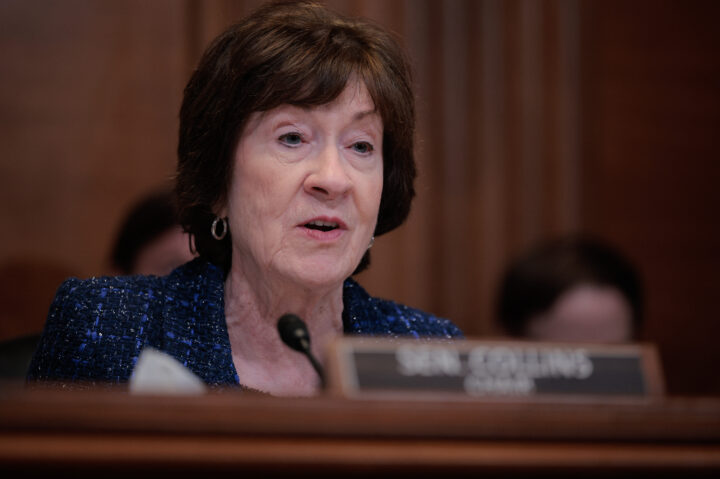
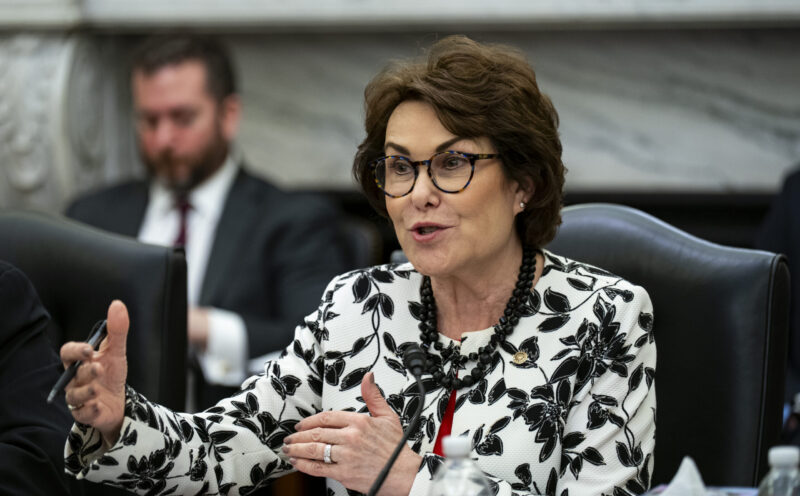
(Photo by Chip Somodevilla/Getty Images)
Senate Appropriations Committee Chair Susan Collins (R-ME) questions U.S. Trade Representative Jamieson Greer during a Commerce, Justice, Science, and Related Agencies Subcommittee hearing in the Dirksen Senate Office Building on Capitol Hill on December 09, 2025 in Washington, DC.


 Add JewishInsider on Google
Senate Appropriations Committee Republicans, in a long-delayed Homeland Security funding bill released on Friday, proposed a modest increase in funding for the Nonprofit Security Grant Program to $330 million.
The program was funded at $274.5 million in 2025 — not counting supplemental funds included in the 2024 national security supplemental bill. The Senate’s proposed increase comes in far below the $500 million to $1 billion that Jewish community advocates and supporters of the program on Capitol Hill have called for.
The proposal is also slightly below the $335 million approved by the House in its version of the bill earlier this year. The Senate proposal sets off a sprint to finalize 2026 government funding when Congress returns in January, ahead of an end-of-month deadline.
With $305 million available in 2024, the program funded less than half of applications, with nearly $1 billion in total funding requested. The Department of Homeland Security has not yet closed or finalized grant applications for 2025, and has not released data on application or acceptance rates for supplemental funding rounds earlier this year.
The explanatory report accompanying the bill — likely reflecting congressional concerns around a lack of transparency about the program — directs the Federal Emergency Management Agency to provide within 180 days a report on 2023, 2024 and 2025 funding grants, the number of applications, and “any quantitative or qualitative results or other outcomes related to such.”
“FEMA is also encouraged to utilize NSGP grants to help nonprofits detect and respond to threats,” the report continues. “The Committee further notes that eligible uses of NSGP grant funding include the acquisition of technology providing immediate notification to emergency 911 services; real-time, actionable intelligence directly to law enforcement and first responders; and other DHS-certified technology designed to prevent and respond to terrorism and other threats.”
It had been unclear just days ago if the Senate Appropriations Committee would release a Homeland Security bill at all, with the top Democrat on the subcommittee, Sen. Chris Murphy (D-CT), saying he was unsure where the process stood and a Republican member telling Jewish Insider that a full-year continuing resolution — which would continue 2025 funding levels through 2026 — was a possibility.
A spokesperson for Murphy told JI the bill was a GOP product, not, as has been standard, a negotiated draft among both parties.
Lauren Wolman, the Anti-Defamation League’s senior director of government relations and strategy, said that the allocation “is a major step forward and reflects the gravity of the threats facing Jewish communities today.”
“Demand for this program continues to far outpace available funding, and we urge Congress to ensure every at-risk nonprofit can access the security resources it needs,” Wolman continued.
Nathan Diament, the executive director of public policy for the Orthodox Union, said that the Senate proposal is “a useful start to the process.”
“Obviously, in light of recent events, we will be working with our partners to increase that funding level in the final bill,” Diament said. “We appreciate that the Senate bill is on par with what the House reported out earlier this year.”
Michael Masters, the CEO of the Secure Community Network, emphasized that the NSGP funding is critical.
“SCN is deeply appreciative of the Committee’s continued commitment to protecting faith-based communities in today’s unprecedented threat environment. The Nonprofit Security Grant Program has proven time and again to save lives by helping institutions targeted by terror and hate to deter, prevent, and respond to attacks,” Masters said. “At a time when the faith-based community has continued to find itself under attack, this funding is essential to safeguarding communities and preserving our ability to gather and worship — a fundamental right we must fight to preserve, as Americans.”
Rachel Dembo, director of policy and government relations for the Jewish Federations of North America, thanked the committee for the proposal.
“This is a meaningful step forward as threats to faith communities remain high, particularly for the Jewish community,” Dembo said in a statement. “While more work remains to be done, we urge lawmakers to conference and pass this annual funding bill and keep building toward funding levels that reflect today’s threat environment.”
More Stories
diplomats declared
Israel approves new consuls-general in San Francisco, Houston
rabbinic rebuke
Over 800 rabbis speak out against Mamdani as threat to ‘safety and dignity of Jews in every city’

doha forum dispatch
Hillary Clinton reiterates concerns about anti-Israel ‘propaganda’ targeting American youth
ON THE HILL
2026 defense bill includes unconditional repeal of Syria sanctions, Iraq war authorizations
PLAYING AGAINST TYPE
Pat Ryan endorses Zohran Mamdani for New York City mayor